
We use cookies, including third-party cookies from Google to serve personalized ads through AdSense, to operate this site and understand how it is used. By continuing to browse, you accept this use. See our Privacy Policy and Terms of Use for details, including how to opt out of personalized advertising.
Accept
SmartData CollectiveSmartData Collective
  • Analytics
    AnalyticsShow More
    What Kind of Problem-Solving Distinguishes Data Analysts From Software Engineers -- AI-generated illustration
    What Kind of Problem-Solving Distinguishes Data Analysts From Software Engineers
    7 Min Read
    chatgpt image jul 21, 2026, 04 34 30 pm
    4 Core Benefits of Predictive Maintenance after Vibration Analysis
    10 Min Read
    How Does Data Mining Boost Customer Satisfaction in Logistics? Harnessing Analytics for Results -- AI-generated illustration
    How Does Data Mining Boost Customer Satisfaction in Logistics? Harnessing Analytics for Results
    11 Min Read
    chatgpt image jul 13, 2026, 04 23 45 pm
    How Data Analytics Helps Companies Improve User Engagement
    19 Min Read
    chatgpt image jul 13, 2026, 03 59 46 pm
    How Data Analytics Improves Multi-Location Search Strategies
    10 Min Read
  • Big Data
  • BI
  • Exclusive
  • IT
  • Marketing
  • Software
Search
© 2008-25 SmartData Collective. All Rights Reserved.
Reading: Interesing debate on business process and decisions
Share
Notification
Font ResizerAa
SmartData CollectiveSmartData Collective
Font ResizerAa
Search
  • About
  • Help
  • Privacy
Follow US
© 2008-23 SmartData Collective. All Rights Reserved.
SmartData Collective > Business Intelligence > CRM > Interesing debate on business process and decisions
Business IntelligenceCRMData MiningPredictive Analytics

Interesing debate on business process and decisions

JamesTaylor
JamesTaylor
5 Min Read
Interesing debate on business process and decisions
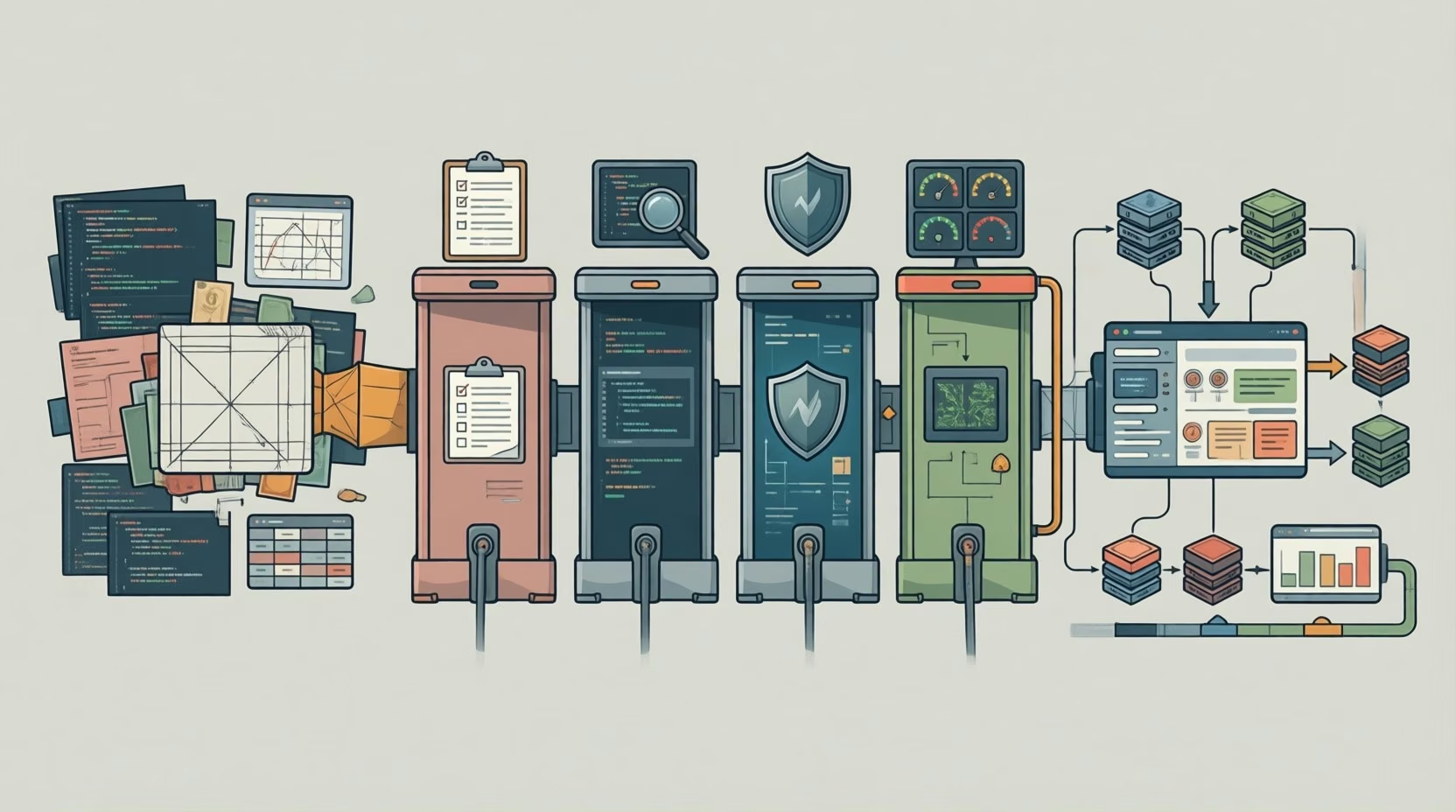
Illustration generated with qwen-image-Q4_K_M (local ComfyUI) + quality 20-step CFG 4.
SHARE

Copyright © 2009 James Taylor. Visit the original article at Interesing debate on business process and decisions.

Syndicated from ebizQ

I have posted a couple of times recently on the interaction of decisions and processes – Another way decision management and process interact, More on keeping decisions and processes separate and Here’s how decision management simplifies process management. This last one prompted Stephen Zisk (of Pega) and Dan Selman (of ILOG) to respond.

The good news is that we are all in agreement on the silliness of using BPMN branches to manage decisions and on the value of a separation of concerns between process and decision. Then it gets interesting:

More Read

5 Challenges Your Company Has to Overcome to Succeed in Data Mining
Location Intelligence and Mobile BI: Advancing Customer Relations in the Finance and Banking Sector
Data-Driven eCommerce Case Study: Cohorts and Segmentation
First Look – Starview
How To Develop A Top-Notch Data Warehousing System

First the issue of changes to data. Stephen makes the point that

“if someone needs to add a piece of data to the calculation…you need to change three things to handle the new data: the interface to the decision service, the process activity to pass in the data, and the decision rule itself.”

and contrasts this with a merged process/rule environment such as Pega’s. Dan takes issue with this arguing that

“Services have well defined interfaces…If you share amorphous state between a process and a set of rules then you explicitly tie your decision service to the process. This is an anti-pattern IMO”

Me, I think that Stephen has a point but that it does not obviate the value of a clear division. After all, the discount calculation might be made in several places and so any change to it has a greater impact than just this one process. If I tie it into this process then I don’t necessarily make it easier to change if there are other processes using it. I can and should refactor the decision service so that it works with or without the new data element (if I can) and then change each process as and when it makes sense to pass the new data. So, yes it takes three changes but I am not sure that (in the general case) a merged process/rule environment makes a difference to that.

Stephen then goes on to address the second point:

“In your “long-running process” example, what if you need to make a decision based on things that may happen at different stages or even external to the case?…If the sources have different costs and response times, having the decision rule pick which sources it needs to best make the decision would save time and money in most cases. But if you have a separate decision engine, you either have to do the calls for external data inside the decision engine or you have to introduce convoluted processes inside the BPM to support the backward chaining. Resolving the rule in the same “space” as the process engine fixes the problem.”

Dan does not see what he’s getting at here but I think I do. I agree that decision services need to be able to reach out and collect additional data required to make a decision and that limited backward chaining support is ideal for this. I am not fond of decision services that only work with the data passed in for this reason. And I can see how a process/rule engine has more options for this kind of data access. I am not sure it changes the basic dynamic, however, and I still believe a formal separation of the decision from the process (even if you use the same platform for both) is the way to go.

There are lots of examples where processes can be made simpler and more effective using a rules-based process definition (something at which Pega excels) but I don’t think this means that decision services are not a good idea even so.

Love the debate and, like Dan, I agree with Neeli that we need better visualization and refactoring tools between processes and rules.

Share This Article
Facebook Pinterest LinkedIn
Share

Follow us on Facebook

Latest News

Flat editorial illustration: The article's core relationship is the engineering transition from an AI prototype to a production-r
From AI Prototype to Production: Observability and Scalability Requirements for Data-Heavy SaaS Applications
Artificial Intelligence Exclusive
Preparing Data Systems and Governance for a Scaling Global Gaming Brand -- AI-generated illustration
Preparing Data Systems and Governance for a Scaling Global Gaming Brand
Big Data Infographic
How Restaurant POS and Ordering Data Reveal Generational Customer Patterns -- AI-generated illustration
How Restaurant POS and Ordering Data Reveal Generational Customer Patterns
Exclusive Infographic
From Trucks To Data: How Telematics Can Improve Freight Transportation -- AI-generated illustration
From Trucks To Data: How Telematics Can Improve Freight Transportation
Big Data Exclusive Infographic

Stay Connected

1.2KFollowersLike
33.7KFollowersFollow
222FollowersPin

You Might also Like

Business Intelligence for Fairs, Congresses and Exhibitions
Business Intelligence

Business Intelligence for Fairs, Congresses and Exhibitions

8 Min Read
How to Make Your Department More Data-Friendly
Best PracticesBig DataBusiness Intelligence

How to Make Your Department More Data-Friendly

8 Min Read
The Impact Of Artificial Intelligence In Web Design
Artificial IntelligenceExclusive

The Impact Of Artificial Intelligence In Web Design

5 Min Read
ai in marketing
Artificial IntelligenceExclusive

AI Helps Businesses Develop Better Marketing Strategies

9 Min Read

SmartData Collective is one of the largest & trusted community covering technical content about Big Data, BI, Cloud, Analytics, Artificial Intelligence, IoT & more.

Chatbots and SEO: How Can Chatbots Improve Your SEO Ranking?
Artificial Intelligence Chatbots Exclusive
How To Get An Award Winning Giveaway Bot
Big Data Chatbots Exclusive

Quick Link

  • About
  • Contact
  • Privacy
Follow US
© 2008-26 SmartData Collective. All Rights Reserved.
Welcome Back!

Sign in to your account

Username or Email Address
Password

Lost your password?