Cookies help us display personalized product recommendations and ensure you have great shopping experience.

By using this site, you agree to the Privacy Policy and Terms of Use.
Accept
SmartData CollectiveSmartData Collective
  • Analytics
    AnalyticsShow More
    business using business intelligence
    How to Use a Competitive Intelligence Dashboard to Turn Market Data Into Smarter Marketing Decisions 
    9 Min Read
    unusual trading activity
    Signal Or Noise? A Decision Tree For Evaluating Unusual Trading Activity
    3 Min Read
    software developer using ai
    How Data Analytics Helps Developers Deliver Better Tech Services
    8 Min Read
    ai for stock trading
    Can Data Analytics Help Investors Outperform Warren Buffett
    9 Min Read
    media monitoring
    Signals In The Noise: Using Media Monitoring To Manage Negative Publicity
    5 Min Read
  • Big Data
  • BI
  • Exclusive
  • IT
  • Marketing
  • Software
Search
© 2008-25 SmartData Collective. All Rights Reserved.
Reading: How are data transformations represented in PMML?
Share
Notification
Font ResizerAa
SmartData CollectiveSmartData Collective
Font ResizerAa
Search
  • About
  • Help
  • Privacy
Follow US
© 2008-23 SmartData Collective. All Rights Reserved.
SmartData Collective > Uncategorized > How are data transformations represented in PMML?
Uncategorized

How are data transformations represented in PMML?

MichaelZeller
MichaelZeller
6 Min Read
SHARE

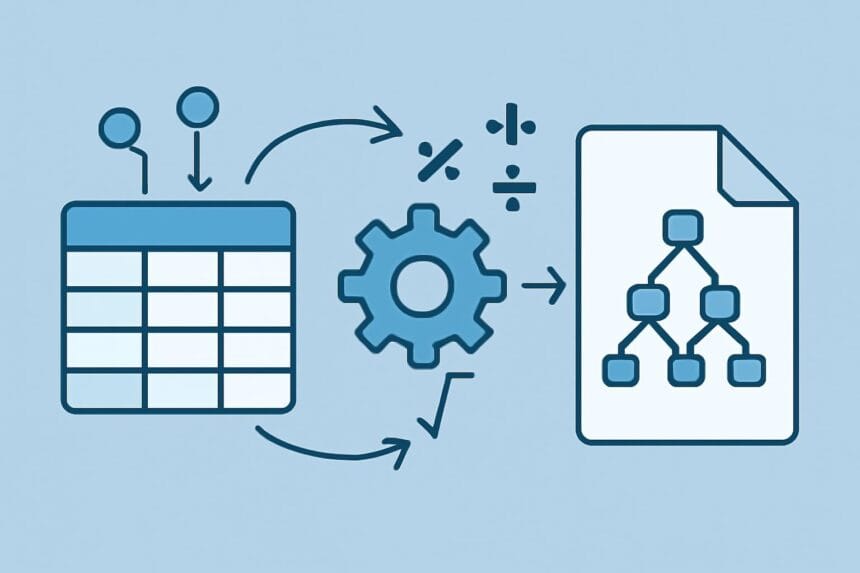
PMML supports several kinds of data transformations. Below, we list the most common together with examples.

Data transformations involved in the pre-processing of the input variables/fields are mainly located inside the following PMML elements: TransformationDictionary and LocalTransformations.

For the formal PMML schema definition of the transformations covered here, please refer to the PMML Transformations page on the DMG website.

Value Mapping
More Read

The Trend for Business Intelligence Software Jobs
Why Your Business Needs Unified Comms
Calculating the Soft Costs of Hadoop
The Future of Cloud Computing
Why Buy The Cow When You Can Hear It Moo For Free?

Value mapping can be used to map discrete values to discrete values. The example below shows how to map a categorical field (color) into a numerical field (derived_color).


Note that in this example, we are mapping yellow to 3, white to 1, blue to 6, and green to 4.

The original input field named color needs to be defined in the DataDictionary element. The derived field, the result of our data transformation is now called derived_color. This field can subsequently be used by the model as an input variable or used as input for another data transformation.

Discretization

Discretization is used to map continuous values to discrete values. The example below shows how to discretize a continuous field (units) into a discrete field (derived_units).


In thi…


PMML supports several kinds of data transformations. Below, we list the most common together with examples.

Data transformations involved in the pre-processing of the input variables/fields are mainly located inside the following PMML elements: TransformationDictionary and LocalTransformations.

For the formal PMML schema definition of the transformations covered here, please refer to the PMML Transformations page on the DMG website.

Value Mapping

Value mapping can be used to map discrete values to discrete values. The example below shows how to map a categorical field (color) into a numerical field (derived_color).


Note that in this example, we are mapping yellow to 3, white to 1, blue to 6, and green to 4.

The original input field named color needs to be defined in the DataDictionary element. The derived field, the result of our data transformation is now called derived_color. This field can subsequently be used by the model as an input variable or used as input for another data transformation.

Discretization

Discretization is used to map continuous values to discrete values. The example below shows how to discretize a continuous field (units) into a discrete field (derived_units).


In this example, we are transforming an interval to a discrete value, more specifically, discretize will transform [1,2[ to 1, [2,3[ to 2, and [3,100] to 3.

The new field is now called derived_units and can be used as input to another transformation or to the model itself.

Normalization

As specified in the DMG website, normalization provides a basic framework for mapping input values to specific value ranges, usually the numeric range [0 .. 1].

NormContinuous

Normalization is used, e.g., in neural networks. In fact, if you export your neural network model using SPSS (starting with version 16), the PMML code generated will contain this kind of transformation for the neural inputs. The R PMML package will also generate a file containing the normalization of input variables for Support Vector Machines (SVMs). The example below was extracted from the Iris_SVM.xml file available in the Zementis website.


The PMML element NormContinuous can be used to implement simple normalization functions such as the z-score transformation (X – m ) / s, where m is the mean value and s is the standard deviation.

NormDiscrete

The NormDiscrete element is used to implement the dummyfication of categorical or ordinal fields. For example, if you have a categorical variable called Marital with the following possible values: Absent, Divorced, Married, Married-spouse-absent, Unmarried, and Widowed, you may want these to be dummyfied (i.e. translated into 0s and 1s) for use by a neural network or SVM. The example below shows the use of element NormDiscrete to accomplish just that.


The set of NormDiscrete instances which refer to input field Marital define a fan-out function which maps a single input field to a set of normalized fields. Note that if Marital is equal to Married, the field derived_MaritalMarried will be assigned a value equals to 1.0 and all other derived_MaritalX fields shown will be assigned values equal to 0.

This code was extrated from the Audit_SVM.xml file available in the Zementis website. It is automatically exported by the R PMML package for SVMs built using the R ksvm (kernlab) package.

Functions

PMML offers several built-in functions, all of which are supported by ADAPA. The list is as follows:

1. +, -, * and /
2. min, max, sum and avg
3. log10, ln, sqrt, abs, exp, pow, threshold, floor, ceil, round
4. uppercase
5. substring
6. trimBlanks
7. formatNumber
8. formatDatetime
9. dateDaysSinceYear
10. dateSecondsSinceYear
11. dateSecondsSinceMidnight

You can find several examples of the use of such functions in the DMG website.

Note that functions such as min, max, sum and avg take a variable number of parameters (derived fields or input fields) and return a single value which you would then assign to a new derived field.

Comprehensive blog featuring topics related to predictive analytics with an emphasis on open standards, Predictive Model Markup Language (PMML), cloud computing, as well as the deployment and integration of predictive models in any business process.

Link to original post

Share This Article
Facebook Pinterest LinkedIn
Share

Follow us on Facebook

Latest News

business using business intelligence
How to Use a Competitive Intelligence Dashboard to Turn Market Data Into Smarter Marketing Decisions 
Analytics Big Data Exclusive Marketing
fda14abd c869 4da5 943c c036ad8efc2e
How Data-Driven Journalists Are Using API News Apps to Improve Reporting
Big Data Exclusive News
0622cae5 f7d7 4f74 84b5 eabd1a823dca
How Data-Driven Grocery Recommendations Help Shoppers Eat Better With Less Effort
Big Data Exclusive
business recovering from data loss
How Data-Driven Businesses Protect MySQL Databases from Shutdown
Big Data Exclusive

Stay Connected

1.2KFollowersLike
33.7KFollowersFollow
222FollowersPin

You Might also Like

Does Your Company Have Energy Intelligence?

5 Min Read

Building a More Powerful Data Quality Scorecard

4 Min Read

Marketers Using Social Media: Do they Get it or are they Panicking?

5 Min Read

More on Light Peak: Very high data rate from the grid to your computer

4 Min Read

SmartData Collective is one of the largest & trusted community covering technical content about Big Data, BI, Cloud, Analytics, Artificial Intelligence, IoT & more.

giveaway chatbots
How To Get An Award Winning Giveaway Bot
Big Data Chatbots Exclusive
AI and chatbots
Chatbots and SEO: How Can Chatbots Improve Your SEO Ranking?
Artificial Intelligence Chatbots Exclusive

Quick Link

  • About
  • Contact
  • Privacy
Follow US
© 2008-25 SmartData Collective. All Rights Reserved.
Welcome Back!

Sign in to your account

Username or Email Address
Password

Lost your password?