Cookies help us display personalized product recommendations and ensure you have great shopping experience.

By using this site, you agree to the Privacy Policy and Terms of Use.
Accept
SmartData CollectiveSmartData Collective
  • Analytics
    AnalyticsShow More
    data analytics
    How Data Analytics Can Help You Construct A Financial Weather Map
    4 Min Read
    financial analytics
    Financial Analytics Shows The Hidden Cost Of Not Switching Systems
    4 Min Read
    warehouse accidents
    Data Analytics and the Future of Warehouse Safety
    10 Min Read
    stock investing and data analytics
    How Data Analytics Supports Smarter Stock Trading Strategies
    4 Min Read
    predictive analytics risk management
    How Predictive Analytics Is Redefining Risk Management Across Industries
    7 Min Read
  • Big Data
  • BI
  • Exclusive
  • IT
  • Marketing
  • Software
Search
© 2008-25 SmartData Collective. All Rights Reserved.
Reading: Data Mining Models: Behavioral Segmentation and Classification
Share
Notification
Font ResizerAa
SmartData CollectiveSmartData Collective
Font ResizerAa
Search
  • About
  • Help
  • Privacy
Follow US
© 2008-23 SmartData Collective. All Rights Reserved.
SmartData Collective > Big Data > Data Mining > Data Mining Models: Behavioral Segmentation and Classification
Data MiningModeling

Data Mining Models: Behavioral Segmentation and Classification

Editor SDC
Editor SDC
4 Min Read
SHARE
Two of the most common applications of data mining models are for behavioral segmentation and classification. In behavioral segmentation, clustering models are used to analyze the behavioral patterns of the customers and identify actionable groupings with differentiated characteristics. Classification models are applied to predict the occurrence of an event (such as churn, purchase of an add-on product etc.) and estimate the event’s propensity.
Two of the most common applications of data mining models are for behavioral segmentation and classification. In behavioral segmentation, clustering models are used to analyze the behavioral patterns of the customers and identify actionable groupings with differentiated characteristics. Classification models are applied to predict the occurrence of an event (such as churn, purchase of an add-on product etc.) and estimate the event’s propensity. Classification (or propensity) models are typically used to optimize direct marketing campaigns for retaining (churn prevention) and expanding (cross / deep / up selling) the relationship with the customers.  
The appropriate data set-up for differs for each of the above applications as outlined below:
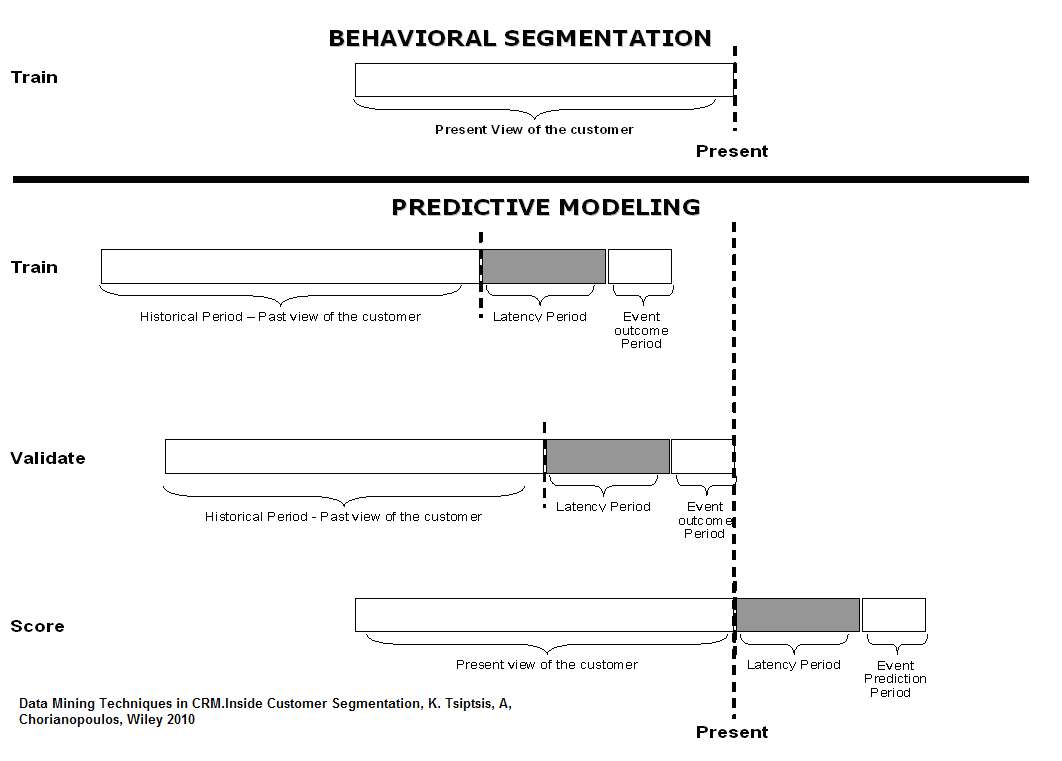
Behavioral segmentation models are based only on the most recent view of the customer and require a simple snapshot of this view, as shown in the next figure. However, since the objective is to identify a segmentation solution founded on consistent and not on random behavioral patterns, the included data should cover a sufficient time period of at least 6 months.

Classification models on the other hand, require the splitting of the modeling dataset in different time periods. To identify data patterns associated with the occurrence of an event, the model should analyze the customer profile before the event occurrence. Therefore, analysts should focus on a past moment and analyze the customer view before the purchase of an add-on product or before churning to a competitor.

Let’s consider for example a typical churn model. During the model training phase, the model dataset should be split to cover the following periods:

  1. Historical period: used for building the customer view in a past time period, before the occurrence of the event. It refers to the distant past and only predictors (input attributes) are used for building the customer view. 
  2. Latency period: It is reserved for taking into account the time needed to collect all necessary information to score new cases, predict future churners and execute the relevant campaigns.
  3. Event outcome period: used for recording the event outcome, for example churned within this period or not. It follows the historical and the latency period and it is used for defining the output field of the supervised model.

The model is trained by associating input data patterns of the Historical period with specific event outcomes recorded in the Event outcome period.

Typically, in the validation phase, the model’s predictive performance is evaluated in a disjoint dataset which covers different time periods. In the deployment phase new cases are scored according to their present view, specifically, according to the input data patterns observed in the period right before the present. The event outcome is unknown and its future value is predicted.


Share This Article
Facebook Pinterest LinkedIn
Share

Follow us on Facebook

Latest News

protecting patient data
How to Protect Psychotherapy Data in a Digital Practice
Big Data Exclusive Security
data analytics
How Data Analytics Can Help You Construct A Financial Weather Map
Analytics Exclusive Infographic
AI use in payment methods
AI Shows How Payment Delays Disrupt Your Business
Artificial Intelligence Exclusive Infographic
financial analytics
Financial Analytics Shows The Hidden Cost Of Not Switching Systems
Analytics Exclusive Infographic

Stay Connected

1.2KFollowersLike
33.7KFollowersFollow
222FollowersPin

You Might also Like

Dick Smith Electronics

2 Min Read

In the past, researchers needed either supercomputers or large…

2 Min Read

E-Government: Out With the Old or In With the New?

4 Min Read

DIALOG Group RCI and Legacy Migration

8 Min Read

SmartData Collective is one of the largest & trusted community covering technical content about Big Data, BI, Cloud, Analytics, Artificial Intelligence, IoT & more.

data-driven web design
5 Great Tips for Using Data Analytics for Website UX
Big Data
AI and chatbots
Chatbots and SEO: How Can Chatbots Improve Your SEO Ranking?
Artificial Intelligence Chatbots Exclusive

Quick Link

  • About
  • Contact
  • Privacy
Follow US
© 2008-25 SmartData Collective. All Rights Reserved.
Go to mobile version
Welcome Back!

Sign in to your account

Username or Email Address
Password

Lost your password?