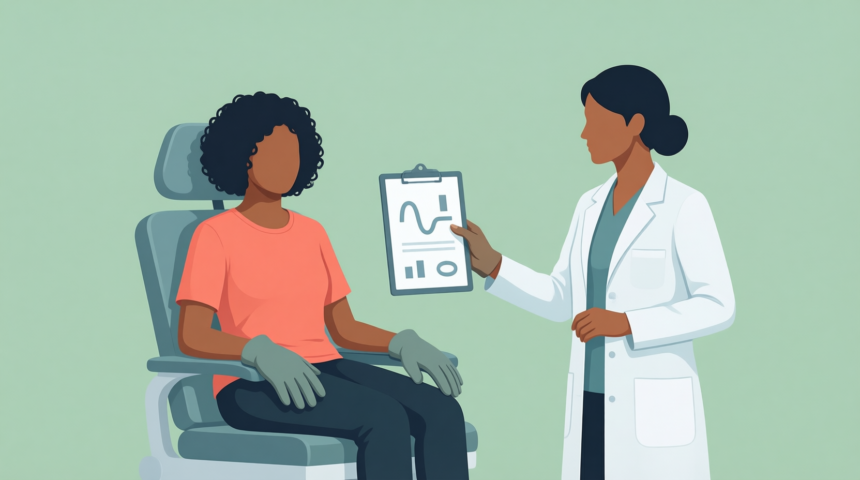
This week, I had the opportunity to tour Carolina Advanced Health. This new facility, which represents a partnership between BlueCross BlueShield of North Carolina (BCBSNC) and University of North Carolina Health Care (UNC), is a model for a patient-centered medical home that places a heavy emphasis on team-based care. Though it has only been open for 6 months, their progress towards re-inventing the concept of patient- and team-centered care is impressive. It also shows how information and technology, combined with novel care models, can offer truly transformative results.
Dr. Thomas K. Warcup has a very interesting job: build a provider organization capable of delivering multi-disciplinary patient-centered care, and avoid being trapped by the legacy thinking that many experienced and talented employees may bring to the table. He appears to be very good at his job. One thing is clear from my first meeting with him: he cares very deeply about enabling new models of effective patient care.
It is hard for me to summarize the model at CAH. On the one hand, it is completely intuitive:
- put the collection of medical resources that should be involved in a patient’s care under the same roof, sharing the same information infrastructure
- develop more time-sensitive and comprehensive care plans that more completely address the complex needs of patients suffering with chronic conditions like diabetes, high cholesterol, asthma, and heart disease
- create different engagement models with those patients that make them feel more empowered and cared for
- reward longer-term health outcomes, not service volumes
Simple. But it is also complex. Dr. Warcup and his team clearly have their work cut out for them, but by all outward signs, they seem to be off to a great start. Consider a primary care setting where:
- Primary care physicians, nurses, care managers, behavioral health specialists, and others all consult regularly on the best interest of a patient.
- Office hours reflect patient’s work lives, and appointments are scheduled within 48 hours
- Examination rooms are intentionally designed as discussion spaces with patients and their families
- Lab equipment produces on-site sample results in minutes using only a finger prick
- Patients are encouraged to email/call their health practitioners
- An automated prescription sample dispenser allows patients to leave their doctor visit with medications in hand
What’s not to like?
As many of you know, I am a huge advocate of agile methods in software engineering. So I was both surprised and delighted to see that some of those principles were actually being applied in CAH’s care team orchestration. The whole care team actually “scrums” around patient care on a regular basis (though I’m not sure they would call it that), using shared status information to drive care decisions and activity coordination. I don’t know whether the borrowing from agile was intentional or coincidental, but it seems like a great idea to me.
Information flow is a critical part of the CAH model, so having a facility that can integrate medical records, claims, pharmacy, and other information about a patient is a huge enabler. Going beyond that, though, CAH also uses a variety of real-time wireless medical devices, telemedicine technologies, survey instruments, and Internet-based information resources to assess, educate, and monitor patients. Dr. Warcup described the benefits of seeing physiological data while patients are in their day-to-day lives, giving practitioners an accurate picture of current medical issues while allowing those same practitioners to dispel unnecessary patient anxieties (and associated costs).
One of the more compelling aspects of the CAH model was an information system that stratifies the current status of every patient on a nightly basis using a green-yellow-red code. As new information enters the system — a medication adherence issue, a medical device reporting a metric out of bounds, etc. — care teams are able to see daily which patients are entering an elevated risk, and can intervene as needed. The system is even smart enough to know which disease conditions “trump” others; of the chronic conditions that CAH currently focuses on, diabetes is currently king.
Seeing this in practice at CAH, I was reminded of a prior blog post where I discussed 9 ways analytics can transform health care. On my undoubtedly incomplete list, #4 was medical indicator selection. The natural tendency in our industry is to codify an ever-growing list of medical measures and rules. The problem with that approach — as we have seen in other market segments like fraud — is that a linear implementation process is unsustainable: it does not reflect the natural system complexity, it does not easily provide discrimination of decision-making priorities, it requires a time delay between available knowledge and implementation of that knowledge, and it becomes exponentially more difficult to model inter-dependencies over time. A smarter approach is one based in analytics, allowing the data to inform you about the patterns, relationships, contigencies, and priorities.
I have no idea how CAH is planning to handle these issues, but seeing an organization like CAH focusing on making more information-based decisions is inspiring, and it gets my brain thinking about the possibilities. In a world where practitioners and institutions will be monitoring thousands of variables and performance measures covering health outcomes, risks, quality, safety, utilization, profitability, and more, I suspect analytics can offer a better way to characterize and prioritize day-to-day work that, like CAH’s operating model, is much more patient-centered and value-oriented.