Cookies help us display personalized product recommendations and ensure you have great shopping experience.

We use cookies, including third-party cookies from Google to serve personalized ads through AdSense, to operate this site and understand how it is used. By continuing to browse, you accept this use. See our Privacy Policy and Terms of Use for details, including how to opt out of personalized advertising.
Accept
SmartData CollectiveSmartData Collective
  • Analytics
    AnalyticsShow More
    chatgpt image jul 21, 2026, 04 34 30 pm
    4 Core Benefits of Predictive Maintenance after Vibration Analysis
    10 Min Read
    How Does Data Mining Boost Customer Satisfaction in Logistics? Harnessing Analytics for Results -- AI-generated illustration
    How Does Data Mining Boost Customer Satisfaction in Logistics? Harnessing Analytics for Results
    11 Min Read
    chatgpt image jul 13, 2026, 04 23 45 pm
    How Data Analytics Helps Companies Improve User Engagement
    19 Min Read
    chatgpt image jul 13, 2026, 03 59 46 pm
    How Data Analytics Improves Multi-Location Search Strategies
    10 Min Read
    cybersecurity efforts
    How Behavioral Analytics and AI Are Redefining Cybersecurity for Boca Raton Businesses
    14 Min Read
  • Big Data
  • BI
  • Exclusive
  • IT
  • Marketing
  • Software
Search
© 2008-25 SmartData Collective. All Rights Reserved.
Reading: The Indispensable Guide to Chart Design and Data Visualization [PART 1]
Share
Notification
Font ResizerAa
SmartData CollectiveSmartData Collective
Font ResizerAa
Search
  • About
  • Help
  • Privacy
Follow US
© 2008-23 SmartData Collective. All Rights Reserved.
SmartData Collective > Big Data > Data Visualization > The Indispensable Guide to Chart Design and Data Visualization [PART 1]
Data VisualizationUncategorized

The Indispensable Guide to Chart Design and Data Visualization [PART 1]

Mark Ledwich
Mark Ledwich
3 Min Read
chart design
SHARE

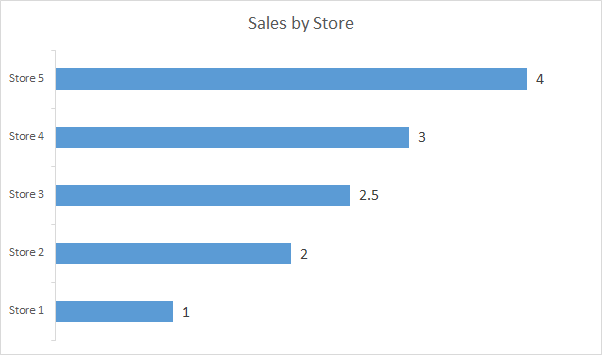
As a follow up to the article “3 Practical Tips for Effective BI Dashboard Design and Implementation” written a few weeks back, I think it’d be beneficial to closely focus on how to most effectively communicate your data using different visual forms. The previous article went into great depth on business context, purpose and overall implementation of visual metrics, but now I’d like to take a more granular approach in analyzing dashboard design—why, when and how to choose from the options afforded to you in many of the BI tools on the market. If you can master the simple techniques to best visualize your data using lines, bars, points and text, then you’re likely already ahead of most professionals in your industry. As you probably already know, business is becoming more and more data-driven and basic chart literacy is becoming as important as good writing for communication. Your visualization should show the information in a clear way that can lead to action on the data. That’s the whole point of business intelligence. Without these skills you’ll miss vital insights that could be gained from your data and you simply won’t be able to convey to others the message you want to tell. Tell me, can you accurately tell which store out of 3 & 4 has more sales? Image What about now? Image Thought so.
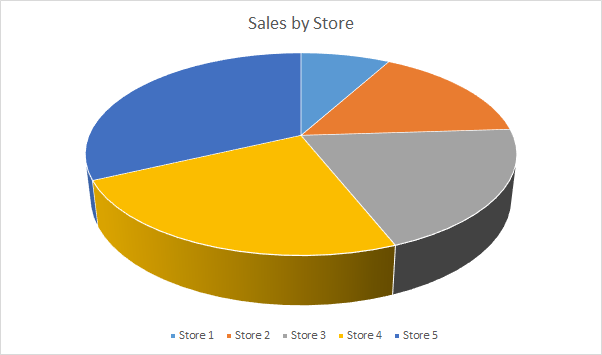
Chart design matters

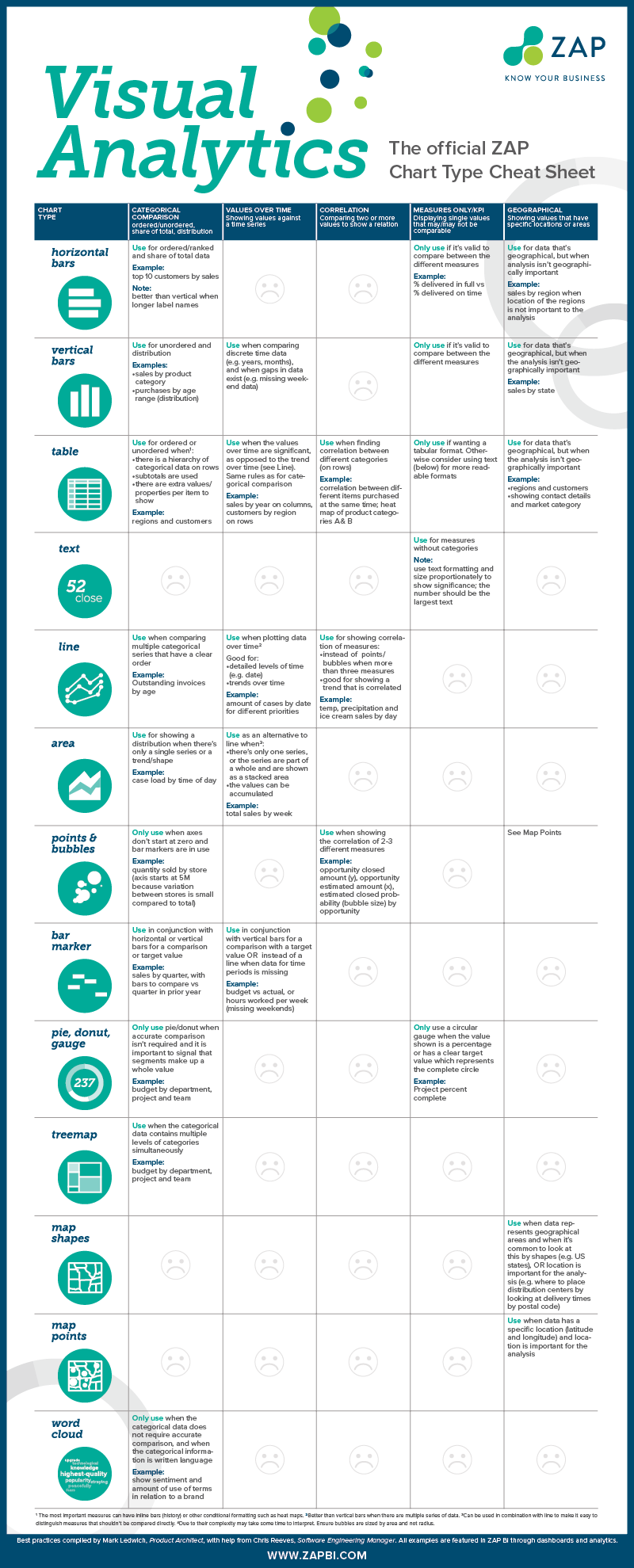
Once you’ve decided what you want to measure, and the actions it drives, then next is how to display data in the best way. The main aspects of this are: chart type selection, basic chart design (axes, legends, colors, chart specific options) and chart design techniques. It’s a rather big topic, and for the basics of chart design I highly recommend The Wall Street Journal Guide to Information Graphics by Dona Wong as a primer. However, you may need something that’s more actionable and easier to execute upon, and that’s what I’ve attempted to do. The purpose of this post is to provide a comprehensive visual cheat sheet for deciding which chart type to use. An additional section, which will be released as part two next week, provides techniques for extending your visualization with additional dimensions of data. To make selecting the chart type as clear as possible, the ZAP BI Chart Type Cheat Sheet below explains when to use each of the different chart types and provides simple examples. The most commonly used chart types are at the top. I recommend reading from left to right, top to bottom to obtain an overview. Then in the future you can use it as a reference. You can click on the image to enlarge it and print! Image
TAGGED:chart design
Share This Article
Facebook Pinterest LinkedIn
Share

Follow us on Facebook

Latest News

Top 8 Multi-Cloud Architecture Tools for Automated Infrastructure Design in 2026 -- AI-generated illustration
Top 8 Multi-Cloud Architecture Tools for Automated Infrastructure Design in 2026
Cloud Computing Exclusive IT
6 Top Agentic SDLC Platforms for Enterprise Engineering Organizations -- AI-generated illustration
6 Top Agentic SDLC Platforms for Enterprise Engineering Organizations
Artificial Intelligence Exclusive
6 Best Runtime Intelligence Tools for Debugging AI-Generated Code in 2026 -- AI-generated illustration
6 Best Runtime Intelligence Tools for Debugging AI-Generated Code in 2026
Artificial Intelligence Exclusive
KYC Verification Vendors Using Network Intelligence to Detect Coordinated Fraud -- AI-generated illustration
KYC Verification Vendors Using Network Intelligence to Detect Coordinated Fraud
Exclusive IT Security

Stay Connected

1.2KFollowersLike
33.7KFollowersFollow
222FollowersPin

SmartData Collective is one of the largest & trusted community covering technical content about Big Data, BI, Cloud, Analytics, Artificial Intelligence, IoT & more.

AI and chatbots
Chatbots and SEO: How Can Chatbots Improve Your SEO Ranking?
Artificial Intelligence Chatbots Exclusive
ai chatbot
How AI Website Chatbots Improve Customer Support and Lead Generation
Chatbots Exclusive

Quick Link

  • About
  • Contact
  • Privacy
Follow US
© 2008-26 SmartData Collective. All Rights Reserved.
Welcome Back!

Sign in to your account

Username or Email Address
Password

Lost your password?