Inventory levels. Sales results. Negative comments on Facebook. Positive comments on Twitter. Shopping on Amazon. Listening to Pandora. Online search habits. No matter what you call it or what the information describes, it’s all data being collected about you.
Thanks to new technologies like Hadoop, once-unquantifiable data (like Facebook conversations and Tweets) can now be quantified. Now, because nearly everything is measurable, everything is measured. The result: companies are spending big dollars to collect, store and measure astronomical amounts of data.
Inventory levels. Sales results. Negative comments on Facebook. Positive comments on Twitter. Shopping on Amazon. Listening to Pandora. Online search habits. No matter what you call it or what the information describes, it’s all data being collected about you.
Thanks to new technologies like Hadoop, once-unquantifiable data (like Facebook conversations and Tweets) can now be quantified. Now, because nearly everything is measurable, everything is measured. The result: companies are spending big dollars to collect, store and measure astronomical amounts of data.

Show me the data!
There’s a name for this movement: Big Data. Not only is it a name, it has been the “it, it” of 2012, possibly trumping “the cloud.”
IDC defines Big Data as projects collecting 100 terabytes of data (hence the name), comprising two or more data formats. Earlier this year, the research firm predicted the market for Big Data technology and services will reach $16.9 billion by 2015, from $3.2 billion in 2010. That’s an astounding 40 percent annual growth rate.
The interesting thing is that IDC expects most of this spending to focus on infrastructure — the plumbing that enables companies to download, collect and store vast amounts of data.
To me, this is a missed opportunity. Why? We need to focus on unlocking the real business benefits from all this data.
Companies have not yet grasped the business potential of all the data pouring in from hundreds of sources—think apps in the cloud, on-premise partner software and from their own enterprise. In effect, businesses haven’t figured out how to make money from this fire hose of disparate data sources.
My point-of-view is that Big Data’s only real value lies in businesses’ ability to transform data into insight they can act on.
This means enabling sales managers to quickly analyze sales reps’ results, view new contracts lost or signed, and react to how actual performance compares against the plan they set months earlier. Help-desk staff could see how individual customers affect sales and profit, showing them when to go above-and-beyond to retain certain customers while allowing low-flyers to churn. Or helping insurance agents to predict kinds and amounts of damage as hurricanes hurtle toward their region.
Steps to Monetize Big Data
To glean value from Big Data efforts, companies need to embrace the real-time value provided by the cloud. Viewing one’s data in real-time through the lens of cloud computing enables anyone, in any company, to make smart business decisions from the mammoth amounts of data, coming from all over the place.
Therefore, companies looking to monetize Big Data need to take these steps:
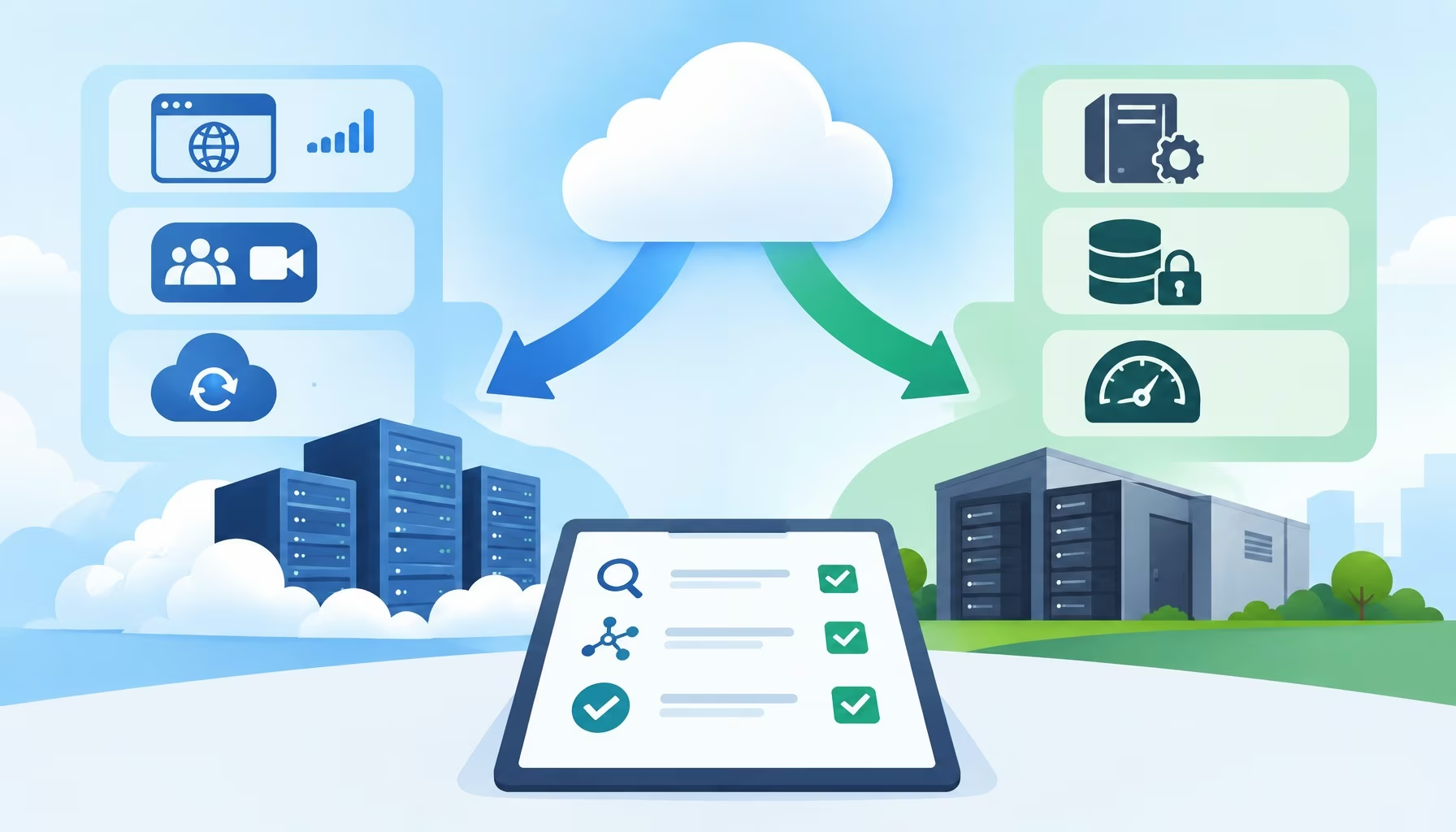
Use the cloud: These days businesses can tap into an enormous range of cloud services. They can subscribe to high-performance infrastructure services like Amazon Web Services, rent platforms as a service (comprising hardware, operating systems, storage and network capacity) from salesforce.com, store information in services like Box or automate billings with companies like Zuora. These are just examples.
Companies can also pick and choose from a long list of cloud-based apps to handle business tasks, from customer relationship management and marketing to human resources and financial management. In fact, I would argue that cloud services become the business application suite, eventually displacing behemoth on-premise packages from SAP or Oracle. Emphasis on “eventually,” since few enterprises are ready to jettison their million-dollar investments in Oracle and SAP.
For this reason, I advise companies to:
Start with what’s important: Forget about separate data sources. Data today spews in from hundreds sources, be it sales and customer data from salesforce.com, inventory levels from SAP, logistics information from your suppliers and employee data from Oracle. Companies run into trouble when they start off boiling the ocean, which is why I suggest companies begin with a few sources and then build up from there.
Fortunately, there is a way, thanks to a new generation of application programming interfaces (APIs) that allows more kinds of software, from different software makers, to communicate with each other, regardless of location. As a result, any company, regardless of size, can access the data it needs to make better decisions.
Which is why my next point is:
Make Big Data insight democratic: Five years ago, only executives at very large companies had access to business intelligence tools that culled patterns from data.
The cloud makes everything democratic — not just access to the data itself, but the insight as well, including best practices that don’t require the expertise of a SQL or a MapReduce programmer. The cloud enables anyone, anywhere, to recognize patterns from data and make smart decisions, faster. And that means any business professional, at any company should be able to monetize their Big Data.
When Big Data finally becomes useful to the rest of us, and not just IT wizards, it will take on an even larger role today and into tomorrow.