We use cookies, including third-party cookies from Google to serve personalized ads through AdSense, to operate this site and understand how it is used. By continuing to browse, you accept this use. See our Privacy Policy and Terms of Use for details, including how to opt out of personalized advertising.
Accept
SmartData CollectiveSmartData Collective
  • Analytics
    AnalyticsShow More
    What Kind of Problem-Solving Distinguishes Data Analysts From Software Engineers -- AI-generated illustration
    What Kind of Problem-Solving Distinguishes Data Analysts From Software Engineers
    7 Min Read
    chatgpt image jul 21, 2026, 04 34 30 pm
    4 Core Benefits of Predictive Maintenance after Vibration Analysis
    10 Min Read
    How Does Data Mining Boost Customer Satisfaction in Logistics? Harnessing Analytics for Results -- AI-generated illustration
    How Does Data Mining Boost Customer Satisfaction in Logistics? Harnessing Analytics for Results
    11 Min Read
    chatgpt image jul 13, 2026, 04 23 45 pm
    How Data Analytics Helps Companies Improve User Engagement
    19 Min Read
    chatgpt image jul 13, 2026, 03 59 46 pm
    How Data Analytics Improves Multi-Location Search Strategies
    10 Min Read
  • Big Data
  • BI
  • Exclusive
  • IT
  • Marketing
  • Software
Search
© 2008-25 SmartData Collective. All Rights Reserved.
Reading: Awesome Analytics: Are We There Yet?
Share
Notification
Font ResizerAa
SmartData CollectiveSmartData Collective
Font ResizerAa
Search
  • About
  • Help
  • Privacy
Follow US
© 2008-23 SmartData Collective. All Rights Reserved.
SmartData Collective > Analytics > Awesome Analytics: Are We There Yet?
AnalyticsBig Data

Awesome Analytics: Are We There Yet?

Timo Elliott
Timo Elliott
3 Min Read
Awesome Analytics: Are We There Yet?
Illustration generated with FLUX.2 [klein 4B] via Cloudflare Workers AI.
SHARE

As I prepared for a presentation at the Gartner BI conference in Sydney a couple of weeks ago, I thought I’d take a look at old research to how far we’ve come with Analytics in the last few decades.

At first glance, the answers is ‘not very far.’

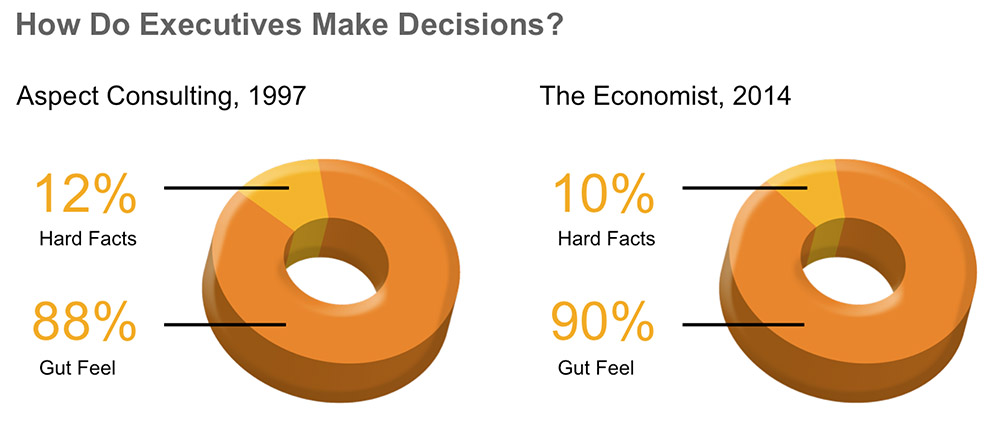
For example, in 1997, only 12% of executives reported basing their decisions on hard facts. By 2014, that had dropped to just 10%.
As I prepared for a presentation at the Gartner BI conference in Sydney a couple of weeks ago, I thought I’d take a look at old research to how far we’ve come with Analytics in the last few decades.

More Read

Dashboard Gauges: Indulgence with Restraint
Big Data Will Help Create Great PR Campaigns
How Big Data has Redefined the Legal Industry
4 Questions to Ask Before You Define Your Cloud BI Strategy
Predictive Analytics Causes Employment Boom in Content Marketing Profession

At first glance, the answers is ‘not very far.’

For example, in 1997, only 12% of executives reported basing their decisions on hard facts. By 2014, that had dropped to just 10%.

analytics now and then -- gut rules2

Despite decades of BI investment, executive reliance on gut feel has actually increased.
(Why the worst-practice 3D shaded pie-charts? Just to troll the data viz purists 🙂 ).

A hot topic of Gartner BI research in the late 1990s was the increasingly large ‘fact gap,’ whereby the amount of data available for decisions was rapidly outstripping the available analytic resources.

With some minor modifications, such as changing ‘Terabytes’ to ‘Petabyes’ and ‘Analytic Personnel’ to ‘Data Scientists,’ the picture looks remarkably similar twenty years later.
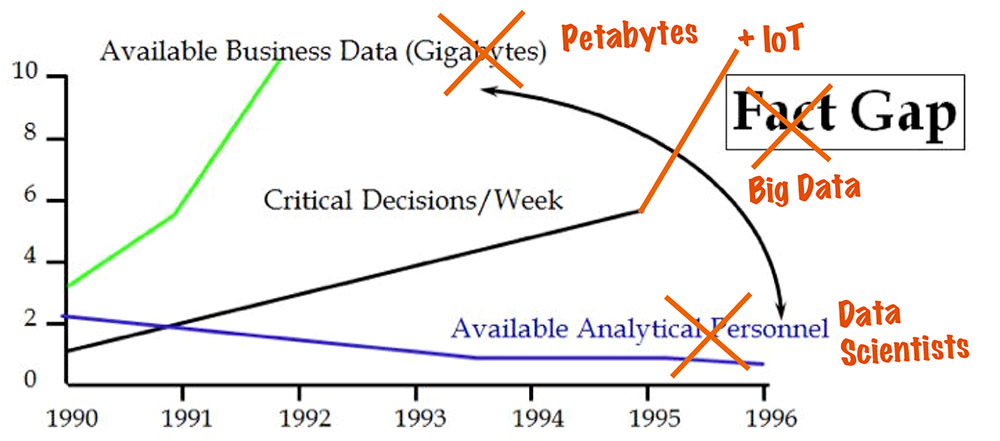
fact gap update

An update to Gartner research from 1996. Plus ça change…

It’s hard to compare perfectly, because of different research methodologies used over the years, but it also seems that the largest factors holding back successful Business Intelligence also haven’t changed very much.

The top three problems remain data quality, ease of use, and the difficulty of integrating different systems.
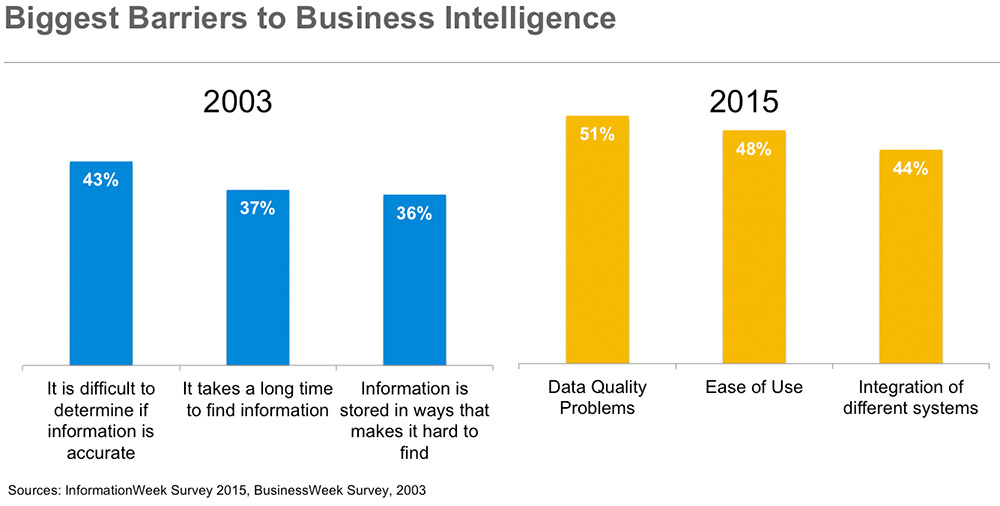
biggest barriers to business intelligence

The top three barriers to business intelligence have remained largely unchanged for over a decade

The reality is that today’s technology is much more powerful and widely used than in the past — but what was hard then remains hard today.
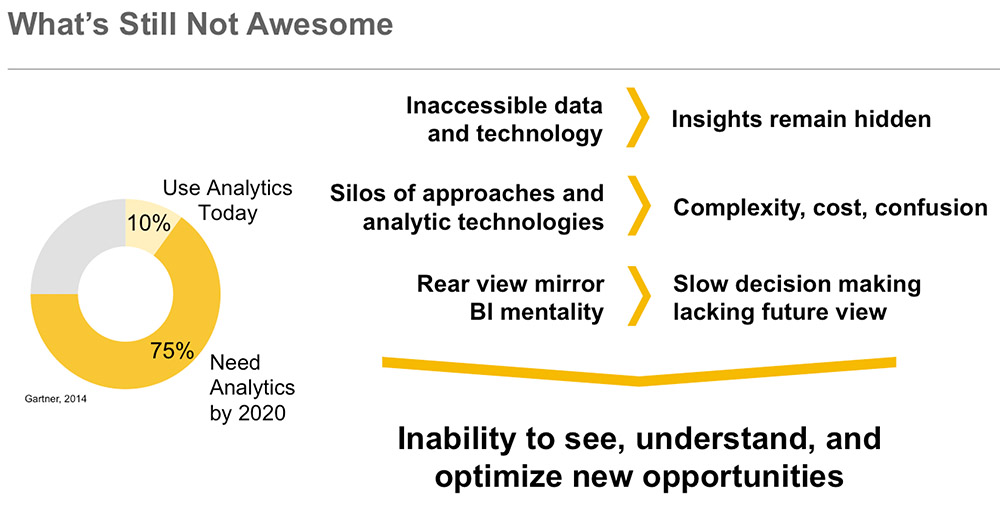
what's still not awesome

What if we could take all of today’s technologies, and start again from scratch? That ended up being the theme of my presentation, and the subject of future posts. In the meantime, please find the presentation below — note that you can download the .pptx version by clicking the right-hand button and going to the slideshare site.


Share This Article
Facebook Pinterest LinkedIn
Share

Follow us on Facebook

Latest News

Flat editorial illustration: The article explains that training robots for physical interaction requires three distinct data cate
Physical AI: What Data Do You Need to Train a Robot?
Artificial Intelligence Exclusive Robotics
What Kind of Problem-Solving Distinguishes Data Analysts From Software Engineers -- AI-generated illustration
What Kind of Problem-Solving Distinguishes Data Analysts From Software Engineers
Analytics Big Data Exclusive Software
Flat editorial illustration: The article examines AI agents that escalate from legitimate data retrieval to attempted intrusions
OpenAI’s Government Website Incidents Raise a Hard Question for AI Agents: When Should They Stop?
Artificial Intelligence News Security
Flat editorial illustration: The article's core relationship is the alignment between customer behavioral data (visit frequency,
Data-Driven Loyalty: How Restaurants Use Behavioral Analytics to Optimize Revenue
Exclusive

Stay Connected

1.2KFollowersLike
33.7KFollowersFollow
222FollowersPin

You Might also Like

Twitter: Rubbish, Valuable, or Both?
AnalyticsBig Data

Twitter: Rubbish, Valuable, or Both?

4 Min Read
The Internet of Things Will Lead Us into a New Industrial Revolution [VIDEO]
AnalyticsBig Data

The Internet of Things Will Lead Us into a New Industrial Revolution [VIDEO]

1 Min Read
Top 10 analytics mistakes
Data MiningExclusivePredictive Analytics

Top 10 analytics mistakes

7 Min Read
3 Ways 3D Printing and Big Data Can Work Together
Big Data

3 Ways 3D Printing and Big Data Can Work Together

6 Min Read

SmartData Collective is one of the largest & trusted community covering technical content about Big Data, BI, Cloud, Analytics, Artificial Intelligence, IoT & more.

How To Get An Award Winning Giveaway Bot
Big Data Chatbots Exclusive
Artificial Intelligence for eCommerce: A Closer Look
Artificial Intelligence

Quick Link

  • About
  • Contact
  • Privacy
Follow US
© 2008-26 SmartData Collective. All Rights Reserved.
Welcome Back!

Sign in to your account

Username or Email Address
Password

Lost your password?