Cookies help us display personalized product recommendations and ensure you have great shopping experience.

By using this site, you agree to the Privacy Policy and Terms of Use.
Accept
SmartData CollectiveSmartData Collective
  • Analytics
    AnalyticsShow More
    predictive analytics risk management
    How Predictive Analytics Is Redefining Risk Management Across Industries
    7 Min Read
    data analytics and gold trading
    Data Analytics and the New Era of Gold Trading
    9 Min Read
    composable analytics
    How Composable Analytics Unlocks Modular Agility for Data Teams
    9 Min Read
    data mining to find the right poly bag makers
    Using Data Analytics to Choose the Best Poly Mailer Bags
    12 Min Read
    data analytics for pharmacy trends
    How Data Analytics Is Tracking Trends in the Pharmacy Industry
    5 Min Read
  • Big Data
  • BI
  • Exclusive
  • IT
  • Marketing
  • Software
Search
© 2008-25 SmartData Collective. All Rights Reserved.
Reading: What is Hadoop?
Share
Notification
Font ResizerAa
SmartData CollectiveSmartData Collective
Font ResizerAa
Search
  • About
  • Help
  • Privacy
Follow US
© 2008-23 SmartData Collective. All Rights Reserved.
SmartData Collective > Big Data > Data Mining > What is Hadoop?
Business IntelligenceData MiningData WarehousingPredictive Analytics

What is Hadoop?

TonyBain
TonyBain
5 Min Read
SHARE

Image via CrunchBase Ok so you are setting out to build the next Google and are considering using a Map/Reduce based data access strategy over traditional SQL. Just as you need a database server to process SQL queries you also…

Image representing Hadoop as depicted in Crunc...Image via CrunchBase

Ok so you are setting out to build the next Google and are considering using a Map/Reduce based data access strategy over traditional SQL.  Just as you need a database server to process SQL queries you also require the underlying infrastructure to manage your data and to execute your Map/Reduce routines.  Hadoop is one such system that is gaining acceptance, being co-developed and implemented for data analytics purposes at Yahoo and Facebook amongst others.

More Read

ReBlog: On Why I Don’t Like Auto-Scaling in the Cloud
6 ways to maximize the value of Business Intelligence
How do the Swedes sweeten performance management?
Reference vs. Referral
San Diego Forum on Analytics — review

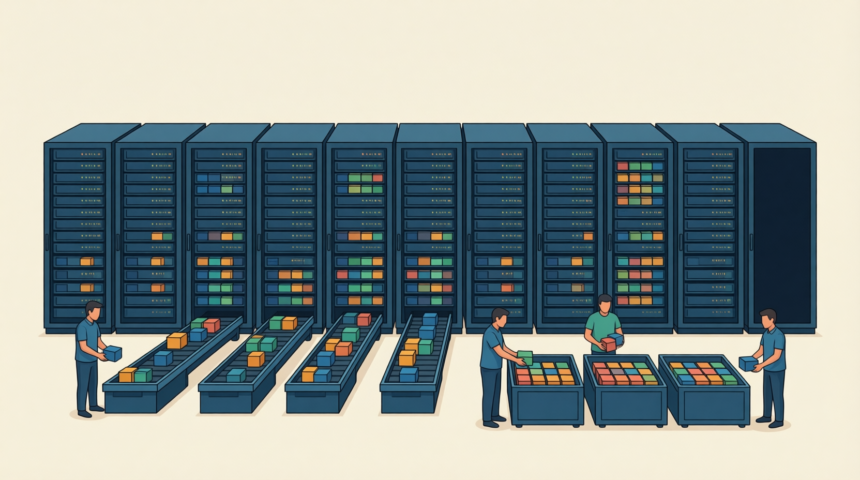
Hadoop is the system that allows unstructured data to be distributed across hundreds or thousands of machines forming shared nothing clusters, and the execution of Map/Reduce routines to run on the data in that cluster.  Hadoop has its own filesystem which replicates data to multiple nodes to ensure  if one node holding data goes down, there are at least 2 other nodes from which to retrieve that piece of information.  This protects the data availability from node failure, something which is critical when there are many nodes in a cluster (aka RAID at a server level).

So will Hadoop outperform a RDBMS?  Well unless you are dealing with very large volumes of unstructured data (hundreds of GB, TB’s or PB’s) and have large numbers of machines available you will likely find the performance of Hadoop running a Map/Reduce query much slower than a comparable SQL query on a relational database.  Hadoop uses a brute force access method whereas RDBMS’s have optimization methods for accessing data such as indexes and read-ahead.  The benefits really do only come into play when the positive of mass parallelism is achieved, or the data is unstructured to the point where no RDBMS optimizations can be applied to help the performance of queries.  Indeed benchmarks from the Hadoop site show performance significantly slower in straight line query performance when compared to a relational DB on small scale tests.

 
MySql 5.0.27Hadoop-0.15.2
DataB-tree disk table (MyISAM)Text files (access_log)
Machine12
Rows5,914,6695,914,669
Results100100
Time4.43 sec172.30 sec

But with all benchmarks everything has to be taken into consideration.  For example, if the data starts life in a text file in the file system (e.g. a log file) the cost associated with extracting that data from the text file and structuring it into a standard schema and loading it into the RDBMS has to be considered.  And if you have to do that for 1000 or 10,000 log files that may take minutes or hours or days to do (with Hadoop you still have to copy the files to its file system).  It may also be practically impossible to load such data into a RDBMS for some environments as data could be generated in such a volume that a load process into a RDBMS cannot keep up.  So while using Hadoop your query time may be slower (speed improves with more nodes in the cluster) but potentially your access time to the data may be improved. 

Also as there aren’t any mainstream RDBMS’s that scale to thousands of nodes, at some point the sheer mass of brute force processing power will outperform the optimized, but restricted on scale, relational access methods.

So while Hadoop and Map/Reduce are gaining more popularity it shouldn’t be considered a like for like alternative to a relational RDBMS for most applications.  It is a specialized tool with a specialized set of criteria that need to be fulfilled to achieve benefit over more traditional approaches.

Related articles by Zemanta
  • Yahoo Search Wants to Be More Like Google, Embraces Hadoop
  • Yahoo’s Supercomputing Initiative Running Hadoop
Reblog this post [with Zemanta]


Link to original postInnovations in information management

Share This Article
Facebook Pinterest LinkedIn
Share

Follow us on Facebook

Latest News

street address database
Why Data-Driven Companies Rely on Accurate Street Address Databases
Big Data Exclusive
predictive analytics risk management
How Predictive Analytics Is Redefining Risk Management Across Industries
Analytics Exclusive Predictive Analytics
data analytics and gold trading
Data Analytics and the New Era of Gold Trading
Analytics Big Data Exclusive
student learning AI
Advanced Degrees Still Matter in an AI-Driven Job Market
Artificial Intelligence Exclusive

Stay Connected

1.2kFollowersLike
33.7kFollowersFollow
222FollowersPin

You Might also Like

Teradata prepares universities for the digital decade

6 Min Read
ai in marketing
Artificial Intelligence

Conversica Alternatives: AI Assistants for Marketing Teams

9 Min Read

5 Ways Predictive Analytics Cuts Enterprise Risk

5 Min Read

IBM Press room – IBM Business Analytics and Optimization -…

1 Min Read

SmartData Collective is one of the largest & trusted community covering technical content about Big Data, BI, Cloud, Analytics, Artificial Intelligence, IoT & more.

data-driven web design
5 Great Tips for Using Data Analytics for Website UX
Big Data
AI chatbots
AI Chatbots Can Help Retailers Convert Live Broadcast Viewers into Sales!
Chatbots

Quick Link

  • About
  • Contact
  • Privacy
Follow US
© 2008-25 SmartData Collective. All Rights Reserved.
Go to mobile version
Welcome Back!

Sign in to your account

Username or Email Address
Password

Lost your password?