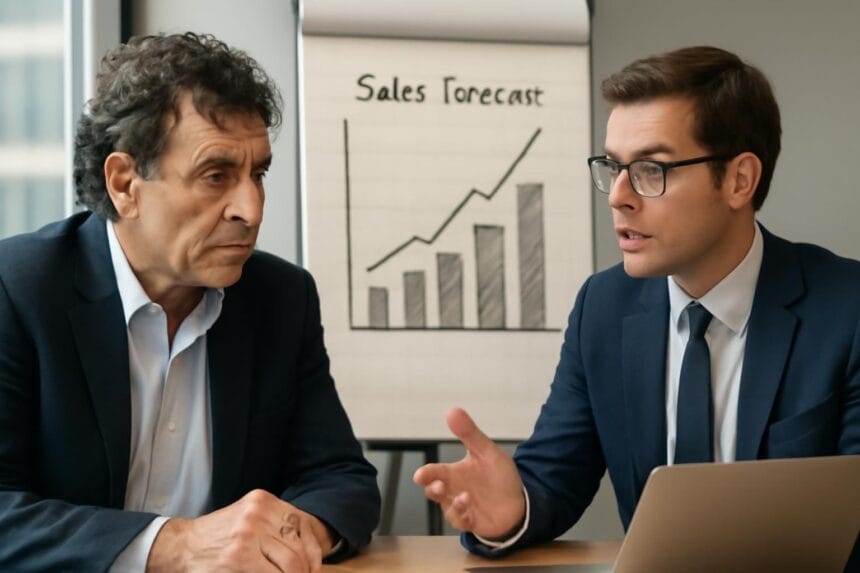
Tom H. C. Anderson and Management Guru Eli Goldratt discuss retail sales forecasting
In Saturday’s post Eli Goldratt and I spoke broadly about economics and globalization and how that will effect marketing. Today I ask him a few question about his most recent project, investigating retail. Eli points out how bad marketing is at forecasting… (Post 5 of 5)
TA: Well, one final question. Your latest book, ‘Isn’t It Obvious’, I believe, will be very interesting for marketers and market researchers as it deals with retail. And I think that market researchers don’t consider the retail component enough, sometimes. We don’t do such a good job of forecasting demand, sales, considering segmentation, shopper basket analysis and so forth.
EG: What, what? Say it again? Not such a good job? I would say that you are doing a lousy job! For heaven’s sake, take the forecast, compare it to the actual sales, ok? A random number generator will give you the same results! And you are talking about not such a good job? Don’t be so nice with yourself!
Let’s take fashion goods, ok? Do you know what the amount of shortages is in a shop in the middle of the season? How many of their SKU’s are missing, do you think?
TA: I have no idea.
EG: Guess.
TA: 50%?
EG: 50%. And have you ever heard of ‘end of season sale’? The other half are the surpluses. A random number generator would do about the same job.
TA: Right, yes. 50% should be random!
EG: Here there’s so much to be gained, but then you have to know how to do it right, and so on. Look. My suggestion is…, you see, in the book ‘Isn’t It Obvious?’ I was talking more from the perspective of the retail itself. What is the biggest problem that’s ignored – not just ignored, they are almost consciously blind to – I’m talking about the shortages and the surpluses and to what extent they are devastating, and to what extent it all stems from the desire to do local optima rather than to look at the system as a whole. And to what extent it is possible to change it and improve the performance beyond the expectation of any retailer.
But then what I found out is that people are missing some of the main messages. So I’m about to release a new version of this book (I’ve finished writing it and it’s now in the hands of my publishers) where I reveal the entire cause and effect of how you convince people to re-examine their positions. How do you convince people to change? What are the elements? What is the whole cause and effect? I would say that this, for you, this is essential.
So why don’t you grab a copy. Go over to Wendy – I don’t know what you’ve done but, if you’ve convinced her to do this interview with me, you can convince her about anything! – and get the new version from her and study how to really question people, how to get the real story. Because, from my experience, so many times when you come in and ask questions from people, you will get misleading answers because they are unaware of the new realities that you’re talking about to them. And this is definitely the case when you’re talking about new services or new products that are not totally in line with what was offered before. And then their answers will be misleading.
So how do you come to the real bottom of it? You don’t have to ask them about these services, because they cannot comprehend it and they don’t believe you. You have to find out how to dig into the real need of the person and what his real concerns are. And deduce it from that. So basically, ‘Isn’t It Obvious’ was a book about retail but in the new version, from the one side its still a book about retail, but from the other side it’s a book about how do you convince people to re-examine their positions. What are all the elements that are involved there? And how do you do it? And what is the homework you have to do? And rather than thinking you’re John Wayne and you can shoot from the hip. From my experience, I am definitely no John Wayne. When I’m shooting from the hip usually I hit my own foot!
What’s the meaning of the preparation? What do you have to do?
TA: Right, right.
EG: All of it is spelled out. I think that the reaction of the 100 and so people that have been shown this was the same reaction that I got from all the other books which is, “It’s common sense”. Then I know it’s working! It’s correct.
TA: I certainly look forward to reading that.
EG: Pay particular attention to what you read. And besides, the other thing is: look. Your perception of TOC is not correct. TOC is not about production. TOC is about how do we look at reality as it is. How do we understand that we cannot judge things in isolation if there are interdependencies between them. How do we do, then, a proper analysis? How do we then find the core problems – and they are very, very deep – and how do we go about constructing a solution that will guarantee a win, win, win. Otherwise you’re getting enormous resistance. And then how do you go about convincing people to the extent that they will say, “Ah! It’s common sense” which is the highest praise for major change.
This is TOC . The whole ability to do such work. So it really doesn’t matter which section of reality you’re dealing with. And I believe that, through the last 30 years, I’ve demonstrated it, I thought, beyond all reasonable doubt. Because, each time, I took a whole different field; huge field, not something very, very tiny and specific and, using exactly the same method, I have brought out the full analysis and the solution to the extent that people say, “It’s common sense”, even though it’s flying directly in the face of common practice.
TA: And where do these insights come from, specifically in regards to consumer understanding?
EG: I’ve said it all along, it’s not something that I invented! I’ve copied it one-to-one from physics.
TA: Right.
EG: I’ve used exactly the same method that is routinely used in physics.
TA: Well I’m certainly looking forward to reading your book and very much appreciate the time you’ve taken today.
EG: And Tom, again, take a group, if you really want to see the application to your field, take a group of your partners, spend a week or two in Israel in order to do a proper analysis on a real case of yours. And then you will understand what I’m talking about. Don’t wait for me to do it because I won’t. So if you want, you have to initiate it!
TA: Yes. Do you have seminars in Israel?
EG: No. In Israel we have the Center so, whenever a business wants to address a problem that we haven’t addressed already 10 times before, which means to do a whole analysis from the beginning, then we ask them to come to the Center and do it with our people. Otherwise, if it’s something that we’ve already done many times before, then we just give them the end logical maps that we have already constructed. Yes, sometimes we have to do some slight modifications with them and then the work is done outside Israel.
TA: I’d love to visit Israel as well, so definitely.
EG: Why not?
TA: Yes. Very good. Well, thank you again so much, Eli, …
EG: Thank you very much.
Tom H. C. Anderson – Anderson Analytics