AI is changing the future of the manufacturing sector. According to one survey, 76% of manufacturing companies have either deployed AI or are in the process of developing an AI system to use in the near future.
More and more the interaction between humans and machines becomes a hot topic in the manufacturing world. Leading manufacturers use AI to integrate automation in their production processes wherever possible, in order to handle repetitive tasks in a more efficient manner. Furthermore, automation allows them to track data and to adjust their systems for even higher productivity and work efficiency. There is no disputing the fact that AI technology has been a force of chance for the manufacturing sector. Among many other benefits, AI is helping with robotic polishing.
Nevertheless, manufacturing companies still rely on manual workers, but they use them to handle complex problems and operations. The real benefit of AI is not that is reduces the need for workers altogether. Rather, AI can help manufacturers get more value out of their existing employees.
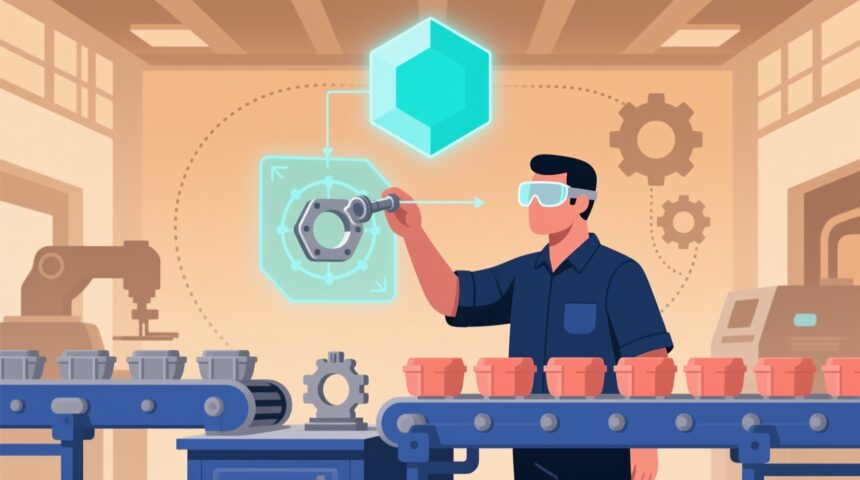
Augmented reality is the solution to empower factories with unequaled tracking and guidance abilities, as well as with opportunities to gain a deeper understanding of their various operations. It is one of the biggest breakthroughs in applied AI technology.
More Read
Due to research on human and machine collaboration, experts are able to design new and better ways of interacting with robots through AI algorithms. Such processes and systems are now more natural than ever before, as they can seamlessly be integrated into the working environment.
How Augmented Reality Add A Deeper Layer To Work Environments through the Use of AI
Research like this shows that manufacturing companies can use advanced AI automation technologies and AR tools to their advantage. Aircada AR helps them identify challenges and find the best solutions to increase their efficiency. They use 3D sensors and motion cameras to identify minute data points with AI. This level of accuracy allows them to identify the exact moments when inefficiencies occur during the production process, thus allowing experts to find the best solutions to optimize their operations.
Here are a few of the main benefits of using AI-driven augmented reality in manufacturing enterprises.
1. Ideal Solution to Training And Upskilling Challenges
AR solutions that use complex AI algorithms can help manufacturing companies to train and upskill their employees with a maximum of efficiency and with the minimum costs possible. Whatever the size of your business, you can scale digital AR work instructions to match your needs. You can develop custom training for each and every individual in your factory, as well as programs that target enterprise levels. You can simply switch between programs as needed with AI management tools, in order to stay relevant and to make the most out of your investment in AR training tools. You’ll be able to provide effective training to both beginners and extremely experienced technicians.
Digital work instructions offer the benefit of standardized training. While human trainers may deliver their programs in more or less effective ways, digital instructions are always going to be the same, as machines don’t get ill and they aren’t subject to emotional fluctuations. Therefore, your AI has the advantage of being far more objective. By connecting all systems, you can ensure that information gets to its recipients right on time, and without any lapses.
2. Digital Work Instructions
In the same way, AR work instructions guide your employees through standardized processes, thus minimizing the risk of error. Rather than having your workers read about multiple actions at once, you can have an AR tool to project work instructions directly onto the work surface. Workers will get their guidance as they need it, step after step, until they complete the task at hand. This reduces time spent working and leaves no room for error, since workers have to put up with lower cognitive loads.
3. Product Variation
You only need to write your work instructions once. Then, you can add them to every AR system in your factory. Workers will be able to adapt to the different variations of a product much faster and with fewer glitches. A barcode scan is everything you need to allow your AR software to connect to a PLC system or to your enterprise MEC to find and use the proper work instructions for that specific situation. Automation is the future and companies that don’t adapt to it will be the first to disappear. The future belongs to those who are flexible enough to integrate all of these modern technologies into their production processes.
4. Quality Assurance
AR solutions that are guided with AI can incorporate inspections that don’t hinder effective production time. You can save a lot of money and time this way.
5. Ergonomics
AR displays digital overlays onto the work surface, allowing you to gain in efficiency. This is one of the biggest benefits of using AI in the manufacturing sector.