We use cookies, including third-party cookies from Google to serve personalized ads through AdSense, to operate this site and understand how it is used. By continuing to browse, you accept this use. See our Privacy Policy and Terms of Use for details, including how to opt out of personalized advertising.
Accept
SmartData CollectiveSmartData Collective
  • Analytics
    AnalyticsShow More
    chatgpt image jul 21, 2026, 04 34 30 pm
    4 Core Benefits of Predictive Maintenance after Vibration Analysis
    10 Min Read
    How Does Data Mining Boost Customer Satisfaction in Logistics? Harnessing Analytics for Results -- AI-generated illustration
    How Does Data Mining Boost Customer Satisfaction in Logistics? Harnessing Analytics for Results
    11 Min Read
    chatgpt image jul 13, 2026, 04 23 45 pm
    How Data Analytics Helps Companies Improve User Engagement
    19 Min Read
    chatgpt image jul 13, 2026, 03 59 46 pm
    How Data Analytics Improves Multi-Location Search Strategies
    10 Min Read
    cybersecurity efforts
    How Behavioral Analytics and AI Are Redefining Cybersecurity for Boca Raton Businesses
    14 Min Read
  • Big Data
  • BI
  • Exclusive
  • IT
  • Marketing
  • Software
Search
© 2008-25 SmartData Collective. All Rights Reserved.
Reading: Self-Service Data Warehousing for Business People with SAP Information Composer
Share
Notification
Font ResizerAa
SmartData CollectiveSmartData Collective
Font ResizerAa
Search
  • About
  • Help
  • Privacy
Follow US
© 2008-23 SmartData Collective. All Rights Reserved.
SmartData Collective > Big Data > Data Warehousing > Self-Service Data Warehousing for Business People with SAP Information Composer
Business IntelligenceData Warehousing

Self-Service Data Warehousing for Business People with SAP Information Composer

Timo Elliott
Timo Elliott
4 Min Read
SHARE

infocomposerbanner

infocomposerbanner

I started my career talking about self-service BI, with a product called “Skipper SQL” that let business people flexibly access information using the “objects” of their business: – sales, revenue, products, customer, etc. (you can probably guess what the product name changed to). For the first time, you didn’t need to be a computer expert to access data.

More Read

Outages: Cloud Customers Cry Out for Communication
R 2.11.0 released
Big Data and AI Are Helping the Aviation Industry Reach New Heights
Location Intelligence: Driving Competitive Advantage in the Retail Industry
Why AI Technology For YouTube Marketers Is Viewed As A Godsend

But on the back end, it has always been the job of an  expert to actually gather the data and put it in a format that people could use to access the data (data mart, data warehouse, OLAP cube…). In large part, this has been because of the complexity of creating a data warehouse that is robust enough to provide fast, convenient access.

But newer in-memory architectures like SAP HANA are eliminating a lot of the need for redundant layers, and making it easy to analyze detailed, on-optimized data sets. This, in turn, makes it easier to allow business people and departments to gather their own data, upload it, and combine/compare it with corporate sources.

Some of these solutions are separate, add-on solutions to the central corporate environment (such as Excel or PowerPivot). These meet the basic business need, but create new problems in the form of new data silos that have to be managed and secured. These types of solutions have resulted in business-led “rogue” BI implementations, created when central BI is too slow to provide more central solutions. These are the BI equivalent of fast-food: we know it’s bad for us in the long term, but they are at least better than going hungry.

The better solution would be a “balanced diet” — to provide a centralized, corporate environment that not only provides trusted, secure corporate data, but also provides “sandboxes” or “user areas” that let business people upload and manage their own data on the same system. This has been a recurring theme in my “BI of the future” presentations over the years, and it’s not a new idea, as Mark Madsen pointed out in a recent TDWI video. He talks about about the origins of data warehousing as envisaged by Barry Devlin and others, and pointed out that this type of personal store was very much part of that original vision.

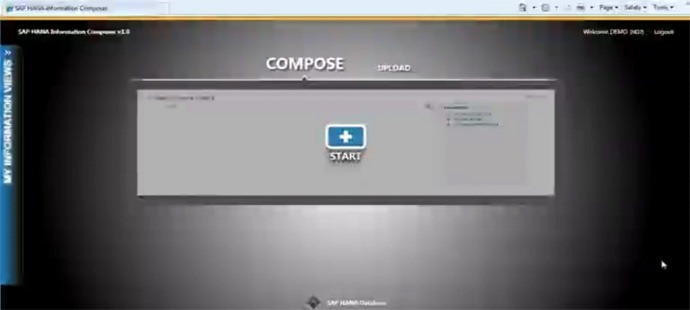
The next version of SAP HANA (SP3) delivers a first version of “self-service data warehousing”. It includes a new web-based application called “Information Composer” that lets business people clean, upload, and model their own data, and combine it with trusted corporate sources. There hasn’t yet been a lot of communication about the product, but there’s a fifteen-minute walkthrough video available on the Experience SAP HANA website and you can read the Information Composer documentation.

Because the underlying platform is HANA, data access is already available through the full range of SAP BusinessObjects products. Information Composer is a great opportunity for organizations to regain control over BI installations, allowing the optimal combination of central administration and low total costs of ownership without having to sacrifice the flexibility required by business people.

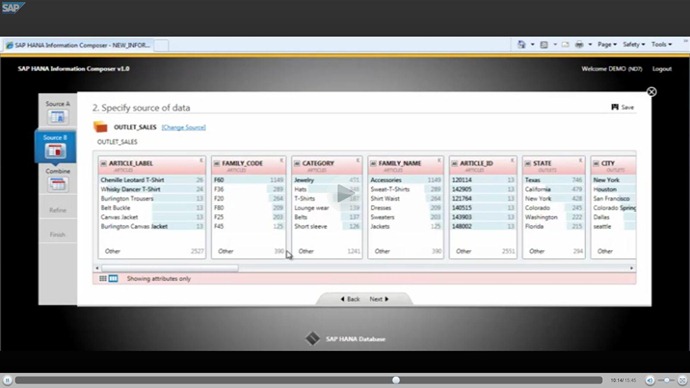
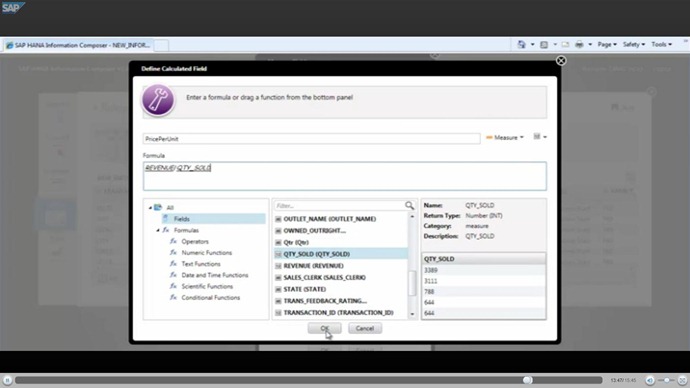
Here are a few examples screenshots from the video. Cleansing data:
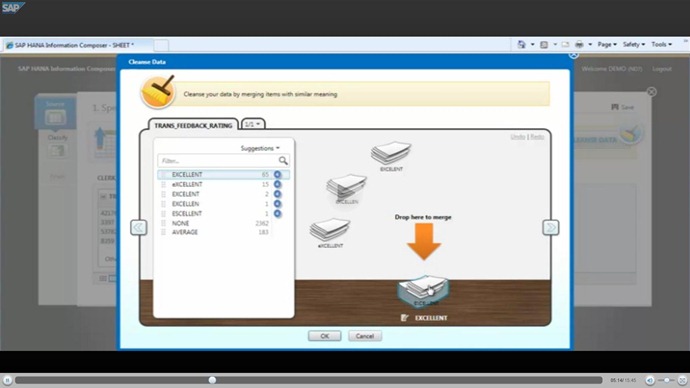
cleansing-data

Finding suitable corporate data:

corporate-data

Choosing how to combine different sources
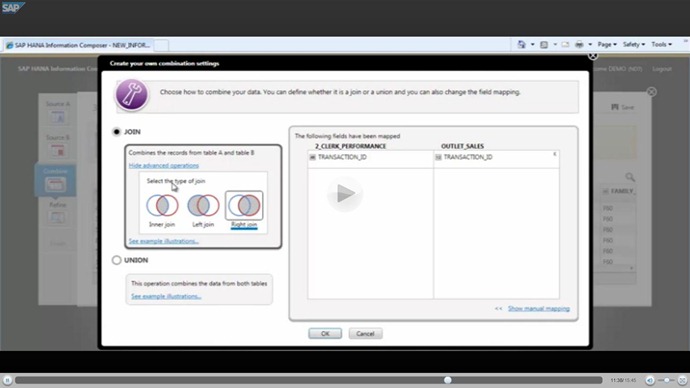
joins

Adding new calculated fields

calculations

Share This Article
Facebook Pinterest LinkedIn
Share

Follow us on Facebook

Latest News

What Your Brand Misses That Data Reveals -- AI-generated illustration
What Your Brand Misses That Data Reveals
Big Data Exclusive Infographic
5 Common Mistakes Businesses Make During the Risk Assessment Process -- AI-generated illustration
5 Common Mistakes Businesses Make During the Risk Assessment Process
Business Intelligence Exclusive Risk Management
Best Age Estimation Software in 2026: Which Facial Age Providers Actually Hold Up -- AI-generated illustration
Best Age Estimation Software in 2026: Which Facial Age Providers Actually Hold Up
Artificial Intelligence Exclusive Machine Learning
Top 8 Multi-Cloud Architecture Tools for Automated Infrastructure Design in 2026 -- AI-generated illustration
Top 8 Multi-Cloud Architecture Tools for Automated Infrastructure Design in 2026
Cloud Computing Exclusive IT

Stay Connected

1.2KFollowersLike
33.7KFollowersFollow
222FollowersPin

You Might also Like

Smarter healthcare is instrumented, so our health systems can…

2 Min Read

Do not make the biggest survey mistake!

2 Min Read

Paul Kedrosky, “the man who counts ladders”

3 Min Read

Our technology collects content from thousands of high-quality…

1 Min Read

SmartData Collective is one of the largest & trusted community covering technical content about Big Data, BI, Cloud, Analytics, Artificial Intelligence, IoT & more.

ai is improving the safety of cars
From Bolts to Bots: How AI Is Fortifying the Automotive Industry
Artificial Intelligence
ai chatbot
The Art of Conversation: Enhancing Chatbots with Advanced AI Prompts
Chatbots

Quick Link

  • About
  • Contact
  • Privacy
Follow US
© 2008-26 SmartData Collective. All Rights Reserved.
Welcome Back!

Sign in to your account

Username or Email Address
Password

Lost your password?