Cookies help us display personalized product recommendations and ensure you have great shopping experience.

By using this site, you agree to the Privacy Policy and Terms of Use.
Accept
SmartData CollectiveSmartData Collective
  • Analytics
    AnalyticsShow More
    predictive analytics risk management
    How Predictive Analytics Is Redefining Risk Management Across Industries
    7 Min Read
    data analytics and gold trading
    Data Analytics and the New Era of Gold Trading
    9 Min Read
    composable analytics
    How Composable Analytics Unlocks Modular Agility for Data Teams
    9 Min Read
    data mining to find the right poly bag makers
    Using Data Analytics to Choose the Best Poly Mailer Bags
    12 Min Read
    data analytics for pharmacy trends
    How Data Analytics Is Tracking Trends in the Pharmacy Industry
    5 Min Read
  • Big Data
  • BI
  • Exclusive
  • IT
  • Marketing
  • Software
Search
© 2008-25 SmartData Collective. All Rights Reserved.
Reading: Responding to a Follower’s Question: Why Keep Data Replication to a Minimum?
Share
Notification
Font ResizerAa
SmartData CollectiveSmartData Collective
Font ResizerAa
Search
  • About
  • Help
  • Privacy
Follow US
© 2008-23 SmartData Collective. All Rights Reserved.
SmartData Collective > Big Data > Data Mining > Responding to a Follower’s Question: Why Keep Data Replication to a Minimum?
Data MiningData QualityData Visualization

Responding to a Follower’s Question: Why Keep Data Replication to a Minimum?

Rob Armstrong
Rob Armstrong
4 Min Read
SHARE

I got an e-mail from one of my followers (I say this in the hopes there are many more!).  In my blog post “What will you tolerate?” I provided a sample of guiding principles.  One of them was the suggestion that data replication be kept to a minimum.  The reader wanted to get a bit more depth to that point.

I got an e-mail from one of my followers (I say this in the hopes there are many more!).  In my blog post “What will you tolerate?” I provided a sample of guiding principles.  One of them was the suggestion that data replication be kept to a minimum.  The reader wanted to get a bit more depth to that point.

Going with the theory that if one person in the audience has that question there may be several more with the same thought, I wanted to just clarify and expand on that point.  I will give the shout out to Jon and thank him for the question (as well as correcting some of my typos).

More Read

Survey Shows Business Intelligence Wants and Struggles of SMBs
Data Mining Interview: Eric Siegel
The Big Data Uprising: It’s Not About Big Or Data
A Visual Delight – Inauguration Day Helicopter Lesson
Top 10 Data Management Issues for 2009

Editor’s note: Rob Armstrong is an employee of Teradata. Teradata is a sponsor of The Smart Data Collective.

So why do I suggest that data replication be minimized.  There are several reasons beyond the very obvious one of disk storage and cost to maintain.

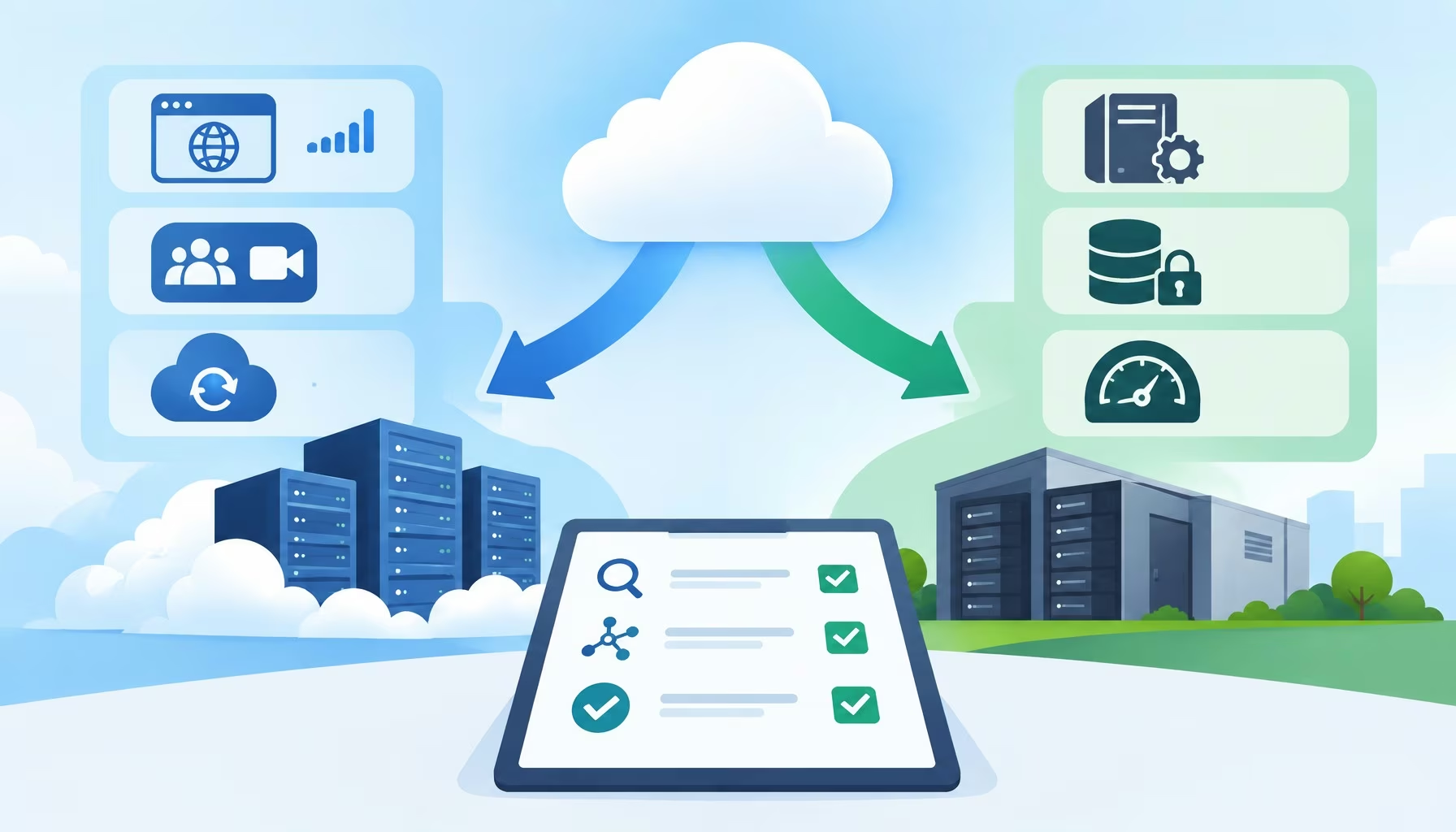
The main point about this guiding principle is that once the data has been cleansed, transformed, and integrated into the core data warehouse, the access should be against that data directly (or through views).  There is very little reason to then extract the data to another database or platform for analytics.  Many people will extract the data into data marts, excel, or other applications. 

Often times this is justified by claiming performance factors, IT barriers, or a variety of other issues.

Whatever the reason, this duplication of data is a problem and should be avoided when possible.  When data is replicated out very rarely do the data rules, data quality, and auditing trails accompany the extract.  This leads to users taking data, possibly transforming it in their on spreadsheets and then sharing that extract with others.  Now the data in the data warehouse no longer matches any reports or analytics from the extracts.  This lead to confusion and finger pointing about where answers are coming from and who’s answers are correct.  Added to this is a problem when a user decided they want to “drill down” from manipulated data but the underlying data in the warehouse no longer matches the reports.

Now this is not to say there is never a time that replicating data is justified.  Clearly, you will need to replicate data for disaster recovery systems.  You may also want to replicate data into a test environment so new applications can be developed and tested against “real data”.  These cases are reasonable as the data is audited for consistency and do not become the source of new analytics.

You may also have to overcome a real technical issue such as an business critical (with proven value) application that requires data to be co-located with the process.  In this case care should be taken to really document what the technical issue is and how it needs to be resolved.  Finally, there needs to be the understanding that the application will be pointed back to the core warehouse once the issue is resolved.  This of course leads us to the whole role of governance but that is another blog.

That help?
Share This Article
Facebook Pinterest LinkedIn
Share

Follow us on Facebook

Latest News

street address database
Why Data-Driven Companies Rely on Accurate Street Address Databases
Big Data Exclusive
predictive analytics risk management
How Predictive Analytics Is Redefining Risk Management Across Industries
Analytics Exclusive Predictive Analytics
data analytics and gold trading
Data Analytics and the New Era of Gold Trading
Analytics Big Data Exclusive
student learning AI
Advanced Degrees Still Matter in an AI-Driven Job Market
Artificial Intelligence Exclusive

Stay Connected

1.2kFollowersLike
33.7kFollowersFollow
222FollowersPin

You Might also Like

SAP BusinessObjects BI and EIM 4.0 Make a BIG Splash

8 Min Read

Anderson Analytics to Receive Advertising Research Foundation Award

1 Min Read

The New York City Fire Department has partnered with IBM to…

2 Min Read

Structured Search Is On The Table

5 Min Read

SmartData Collective is one of the largest & trusted community covering technical content about Big Data, BI, Cloud, Analytics, Artificial Intelligence, IoT & more.

ai in ecommerce
Artificial Intelligence for eCommerce: A Closer Look
Artificial Intelligence
data-driven web design
5 Great Tips for Using Data Analytics for Website UX
Big Data

Quick Link

  • About
  • Contact
  • Privacy
Follow US
© 2008-25 SmartData Collective. All Rights Reserved.
Go to mobile version
Welcome Back!

Sign in to your account

Username or Email Address
Password

Lost your password?