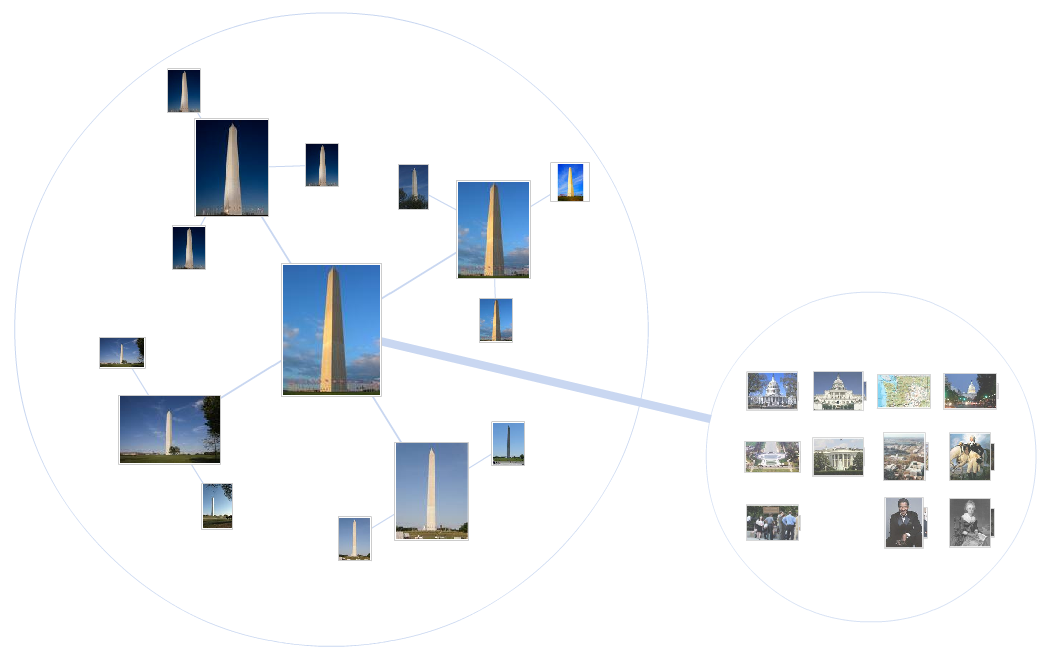
Google’s recently released Image Swirl is slick. But I’ve been struggling to figure out whether it’s useful or simply a showcase for cool technology.
And that’s prompted me to think about the overloaded term “exploratory search.” A while back, I tried to define exploratory search based on what it is not. This time, let me aim to positively characterize what I see as its two primary use cases:
- I know what I want, but I don’t know how to describe it.
- I don’t know what I want, but I hope to figure it out once I see what’s out there.
The first use case cries out for tools that support query refinement or elaboration. Existing tools span a range from suggesting spelling corrections (aka “did you mean”) to offering semantically or statistically related searches that hopefully provide the user with at least a step in the right direction. One of my favorite approaches, faceted search, is primarily used to support query refinement through progressive narrowing of an initial search query.
The second “I don’t know what I want” use case is fuzzier. In the language of machine learning, this use case is unsupervised, while the previous one is supervised. In general, it’s a lot …
Google’s recently released Image Swirl is slick. But I’ve been struggling to figure out whether it’s useful or simply a showcase for cool technology.
And that’s prompted me to think about the overloaded term “exploratory search.” A while back, I tried to define exploratory search based on what it is not. This time, let me aim to positively characterize what I see as its two primary use cases:
- I know what I want, but I don’t know how to describe it.
- I don’t know what I want, but I hope to figure it out once I see what’s out there.
The first use case cries out for tools that support query refinement or elaboration. Existing tools span a range from suggesting spelling corrections (aka “did you mean”) to offering semantically or statistically related searches that hopefully provide the user with at least a step in the right direction. One of my favorite approaches, faceted search, is primarily used to support query refinement through progressive narrowing of an initial search query.
The second “I don’t know what I want” use case is fuzzier. In the language of machine learning, this use case is unsupervised, while the previous one is supervised. In general, it’s a lot harder to define or evaluate outcomes for unsupervised scenarios. Indeed, Hal Daume has argued that we should only do unsupervised learning if we do not have a trustworthy automatic evaluation metric. That’s a strong position, and you can see some of the counterarguments in his comment thread. But, going back to our scenario, it’s really hard to judge the effectiveness of tools like similarity browsing when they support exploration in the absence of any concrete goal.
With that in mind, I’ll reserve judgment on the utility of tools like Image Swirl. To the extent that it aims at the first use case, clustering images for a particular search, I’m ambivalent. I’d prefer a more transparent interface, in which I have more of a sense of control over the navigational experience. I suspect it is more aimed at the second use case, offering a compact visualization of what is out there.
Besides, as some folks have brought up at the HCIR workshops, it’s important that we make information seeking fun. And Swirl certainly scores on that front.