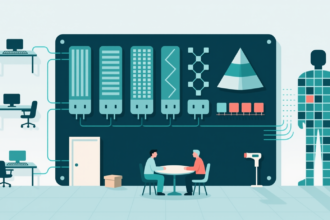
Enterprises now acknowledge the value of having a highly capable workforce. The ever-changing business landscape demands workers to continually upskill and reskill, giving rise to employee training utilization. Most organizations are now reinforcing their human resources and training and development departments to help them address the need.
Large US companies on the average spent $17.7 million on such efforts in 2019. Managing employee training, however, has its own set of challenges. Trainers now deal with increasing volumes of sessions to be conducted. A third of employees also has doubts regarding the effectiveness of training programs. To bridge this, disconnect, enterprises should find ways to empower their training departments and improve the quality of their programs. They should also be able to bridge the actual demands of the workplace and what their programs deliver.
Data show much promise in helping companies solve these issues. The adoption of technologies such as learning management systems (LMS), knowledgebases, and communication and collaboration platforms in employee training and human resources has also increased the data available to enable analytics in playing a role in this business area. Training departments should be able to leverage their data to help them overcome challenges.
Insights and Predictions
Training departments should be able to draw insights on how they can better cater to the actual needs of employees in their respective functions. They can check their LMS data and observe course progression, test results, completion rates, and even feedback to see how well employees respond to the various programs.

Efforts can also correlate HR data, such as employee performance, to check if workers manifest any form of improvement after undergoing training. In doing so, training departments could investigate the performance gaps and what causes them. This may involve eliminating unpopular training programs and promoting those that do lead to improved performance.
In addition, analytics can even be used to explore emerging issues in the organization so that training departments could anticipate future training needs. For example, increasing complaints from employees regarding feeling overworked should encourage training departments to devise programs that could teach employees coping mechanisms and managers be trained in how to help their staff.
Training Automation
Another way data can be used to improve training programs is through automation. In order to address the issue of scheduling, many training programs are now designed to be asynchronous and even self-paced. However, one of the downsides to this is that employees must be disciplined enough to commit to continuing and finishing these courses.
LMS can be configured to track employee progression and, based on completion rates and stagnancy, automatically notify, and encourage learners to continue. Programs can even be gamified to improve engagement.
Training departments can also use data to automate tasks and actual training sessions. Artificial intelligence (AI) can be used for smart scheduling. Chatbots and virtual trainers can also be used to take over the more routine training sessions, such as onboarding sessions on company policies. AI’s improving natural language capabilities are now capable of facilitating employee questions, giving such programs an added dimension of engagement and interaction.
Personalized and Adaptive Instruction
A common challenge for training departments is providing more diverse programs for employees. Not everyone learns the same way. It is best if programs can handle differentiated instruction. Data can be used to track individual training performance and provide specific employees with different tracks, modalities for training, and even testing and assessment.
For instance, an employee who’s always on the field can take micro-trainings instead, where materials are delivered in smaller and granular content such as short explainer videos or infographics rather than requiring them to commit to programs that require longer sessions.
Another pitfall that can be avoided is using standardized tests to readily judge how well learners have performed in the course. Personalized and adaptive instruction can also provide different forms of assessment to check employees’ learning.
Enterprise-wide Benefits
The use of data in training and development brings about company-wide benefits. Insights can help align workplace needs and training programs. Through more relevant training, workers will become more capable in performing their jobs.
Automation also eases some of the pressure from training departments. Allowing technology to take over mundane tasks and courses allows trainers to focus more on higher-value tasks and to handle more nuanced training sessions. Personalized and adaptive training also ensures that all employee progress as instruction can be adjusted to their specific learning styles, creating a more inclusive and engaging environment for all.
Ultimately, effective training and development programs should allow enterprises to have a capable workforce that is more productive and even more resilient, especially during trying times.