We use cookies, including third-party cookies from Google to serve personalized ads through AdSense, to operate this site and understand how it is used. By continuing to browse, you accept this use. See our Privacy Policy and Terms of Use for details, including how to opt out of personalized advertising.
Accept
SmartData CollectiveSmartData Collective
  • Analytics
    AnalyticsShow More
    chatgpt image jul 21, 2026, 04 34 30 pm
    4 Core Benefits of Predictive Maintenance after Vibration Analysis
    10 Min Read
    How Does Data Mining Boost Customer Satisfaction in Logistics? Harnessing Analytics for Results -- AI-generated illustration
    How Does Data Mining Boost Customer Satisfaction in Logistics? Harnessing Analytics for Results
    11 Min Read
    chatgpt image jul 13, 2026, 04 23 45 pm
    How Data Analytics Helps Companies Improve User Engagement
    19 Min Read
    chatgpt image jul 13, 2026, 03 59 46 pm
    How Data Analytics Improves Multi-Location Search Strategies
    10 Min Read
    cybersecurity efforts
    How Behavioral Analytics and AI Are Redefining Cybersecurity for Boca Raton Businesses
    14 Min Read
  • Big Data
  • BI
  • Exclusive
  • IT
  • Marketing
  • Software
Search
© 2008-25 SmartData Collective. All Rights Reserved.
Reading: Founder compares his Wolfram-Alpha to Watson
Share
Notification
Font ResizerAa
SmartData CollectiveSmartData Collective
Font ResizerAa
Search
  • About
  • Help
  • Privacy
Follow US
© 2008-23 SmartData Collective. All Rights Reserved.
SmartData Collective > Business Intelligence > Founder compares his Wolfram-Alpha to Watson
Business Intelligence

Founder compares his Wolfram-Alpha to Watson

StephenBaker1
StephenBaker1
4 Min Read
Founder compares his Wolfram-Alpha to Watson
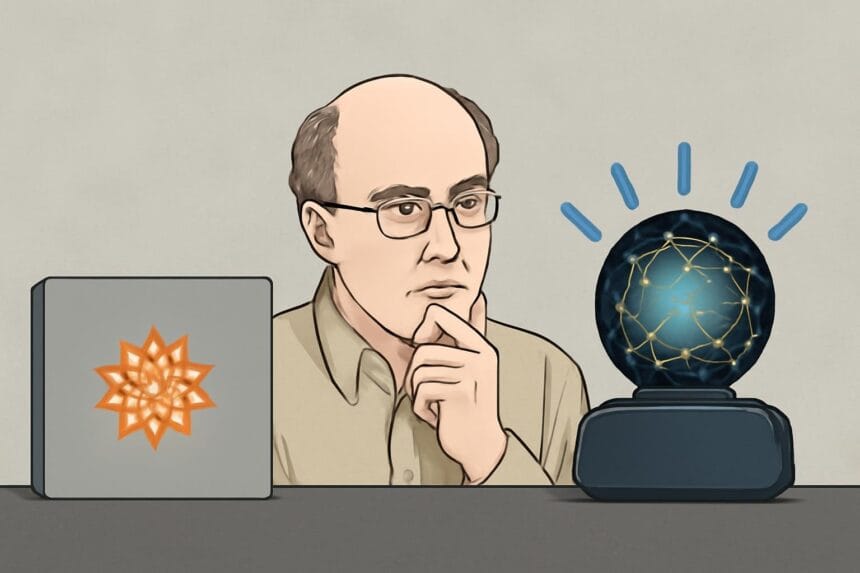
Illustrative image generated with OpenAI gpt-image-1.
SHARE

Stephen Wolfram, founder of Mathematica computing software and the Wolfram-Alpha knowledge engine, takes a fascinating look at the future of search and knowledge–and where a computer like IBM’s Watson fits in. It doesn’t make sense to rehash his post. Better just to read it.

The most interesting aspect to me is his thinking about the future organization of knowledge. No matter how it’s done, it requires human intelligence and input. The question is where the humans get involved. …quot;Somewhere you have to inject human expertise,…quot; Wolfram told a gathering at MIT in September. …quot;You can’t take humans out of the loop….quot;

In a search engine like Google, humans produce their content willy nilly on the Web, and its up to the technology to find order in it. Most of the brainpower works for the search engine (with the exception of the search-engine optimizing crowd, which tries to customize its Web pages so that the engines can find them.)

Watson, in its Jeopardy incarnation, studies a much smaller set of data–about 75 gigabytes. Some of the data is preprocessed, and a lot of thought has gone into which documents provide the machine with the best chance to nail Jeopardy clues. So if the data pouring into Google is like a jungle, Watson’s trove is closer to a game preserve. But still, most of the effort to build Watson went into the algorithms to analyze the data–and much less into preparing the data.

More Read

Old School: Companies That Still Just Don’t Get It
Important Steps to Take to Address the Bias in AI
5 Tips for Streamlining the Supply Chain
Personalization: The Underappreciated Aspect of Self-Service Business Intelligence
AI Reframes The Debate Between VPS & Shared Hosting Options

Wolfram believes in an expanding world of processed, …quot;computible…quot; knowledge. He has a team converting big data sets into a format that his knowledge machine can make sense of. In that sense, it’s a far cry from Google. And of course, unlike search engines, which simply point us toward answers, Wolfram-Alpha carries out computations on the data and provides answers.

Wolfram sees this curating process spreading across the realm of human knowledge, as people work to make their data comprehensible for computers. In recent decades, he said at MIT, people learned the value of turning paper documents into digital ones, which could then be shared across networks. In the next transition, he predicted, people will learn the value of making their documents …ldquo;computable….rdquo; This will mean formatting them so that a machine can read them, draw conclusions and answer questions based on the content. …ldquo;Anything that is not computable,…rdquo; he said, …ldquo;will seem marooned as data on paper does today….rdquo;

Incidentally, in the blog post, Wolfram discusses how his team fed 200,000 Jeopardy clues straight to search engines. The IBM team carried out the same experiment. Some 20-25% of the clues led to answers in the search results. According to Wolfram’s stats, close to 2/3 of the answers could be found in the first document by the search engines. (Of course, it’s human intelligence that ferrets out that answer from the document, and calculates its confidence in it. Watson has to do that work by itself. As I wrote today on IBM’s Smarter Planet blog, a key aspect of Watson’s intelligence is its confidence gauge in its answers.)

TAGGED:knowledge
Share This Article
Facebook Pinterest LinkedIn
Share

Follow us on Facebook

Latest News

Analyst points at colorful circular data dashboard on screen - information technology business metrics
How Fragmented Workplace Tech Undermines Reliable Business Metrics and Reporting
Cloud Computing Exclusive Infographic IT
Using Multi-Source Data and Analytics to Detect Operational Drift Across Franchise Networks -- AI-generated illustration
Using Multi-Source Data and Analytics to Detect Operational Drift Across Franchise Networks
Exclusive Infographic
Beyond The First Impression: The Long-Lasting Impact Of Sensory Marketing -- AI-generated illustration
Beyond The First Impression: The Long-Lasting Impact Of Sensory Marketing
Infographic Marketing
The Infrastructure Gap Slowing Data Center Growth -- AI-generated illustration
The Infrastructure Gap Slowing Data Center Growth
Big Data Cloud Computing Exclusive Infographic IT

Stay Connected

1.2KFollowersLike
33.7KFollowersFollow
222FollowersPin

You Might also Like

What to store in our heads?
Exclusive

What to store in our heads?

10 Min Read
Data – Information – Knowledge – Wisdom
Business Intelligence

Data – Information – Knowledge – Wisdom

7 Min Read

SmartData Collective is one of the largest & trusted community covering technical content about Big Data, BI, Cloud, Analytics, Artificial Intelligence, IoT & more.

Chatbots and SEO: How Can Chatbots Improve Your SEO Ranking?
Artificial Intelligence Chatbots Exclusive
ai chatbot
How AI Website Chatbots Improve Customer Support and Lead Generation
Chatbots Exclusive

Quick Link

  • About
  • Contact
  • Privacy
Follow US
© 2008-26 SmartData Collective. All Rights Reserved.
Welcome Back!

Sign in to your account

Username or Email Address
Password

Lost your password?