Government use of data came under scrutiny after revelations of extensive information gathering by the NSA. Now that the NSA stories have faded from much of the public conscience, lingering concerns about how the government uses private data sources continue to dog public officials.
Contrary to the hopes of government watchdogs, the Executive Branch has not revealed its ground rules of the use of private data sources, collectively known as big data. Some people suspect that the government might already have deals made with big data to mine private information for public use. In the future, ties between the government and big data will likely grow stronger.
Private sector use of big data
Almost every part of private American life leaves data trails tracked by Big Data. Purchasing habits, driving patterns, fashion preferences, religious beliefs, Internet searches and more. Armed with information from big data, corporations can innovate by designing products they already know customers will buy.
More Read
Despite the bad press big data receives, consumers seem comfortable with providing their personal information in exchange for better products. Thanks to big data, customers can enjoy unprecedented innovation from almost every industry. Companies have used big data to improve everything from DNA tests to custom elearning and other educational products. As big data continues its evolution, consumers should expect to have access to more new and improved products and services.
Government use of big data
Unsurprisingly, the IRS tops the list for potential use of big data sources. Via the U.S. Treasury’s Do Not Pay Portal, the government seeks to reduce the amount of money paid to fraudulent recipients. Right now, the portal uses government data, but officials reportedly feel the itch to access private data to reduce further fraud.
The Department of Education has already used big data for its gain, by using private information to target different groups for learning initiatives. In the future, the department reportedly hopes to use private data to evaluate curricula, public schools, and school districts.
Government health care services aim to use big data too with the possible intention of limiting payments for ineffective treatments. Right now, the information about patient treatments and their effectiveness resides in private hands. Bureaucrats hope big data can use this information as a cost-cutting tool that might also deter health care providers from performing treatments that don’t work.
Finally, the U.S. Government aims to use big data to uncover criminal activity such as human trafficking. The government already has a program that collects data from unindexed websites, blends it with government data to identify potential criminals. The government reportedly hopes to expand further its program to keep tabs on users of the so-called dark Internet.
Differences between how the government and private sector use big data
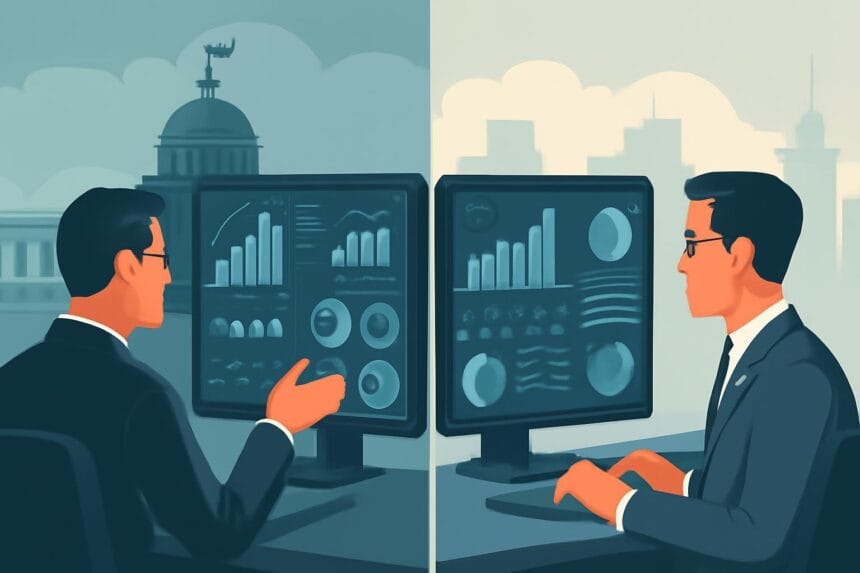
As with government use of big data, privacy issues come into play with private sector use of big data. While consumers seem comfortable sharing their lives with corporations, they seem uncomfortable with sharing their private lives with the government. Perhaps individuals detect a difference between how the government and the privates sector use big data.
Both the government and the private sector use big data for their purposes. The government wants to use big data to increase its power and to exert control over almost every aspect of life. The private sector wants to use big data to provide goods and services to consumers in exchange for money and to improve training delivery methods. Companies that successfully use big data to satisfy customers will enjoy growing influence and wealth. Businesses that fail to use big data in ways that provide value to customers will fail. The government, however, has no obligation to please consumers, and it has little chance of failure.
Regardless of how people feel about government or corporate use of big data, the forces at work will remain at work as long as big data exists. Judging from the current trend, big data and all its benefits and liabilities will stay with us for a long time.