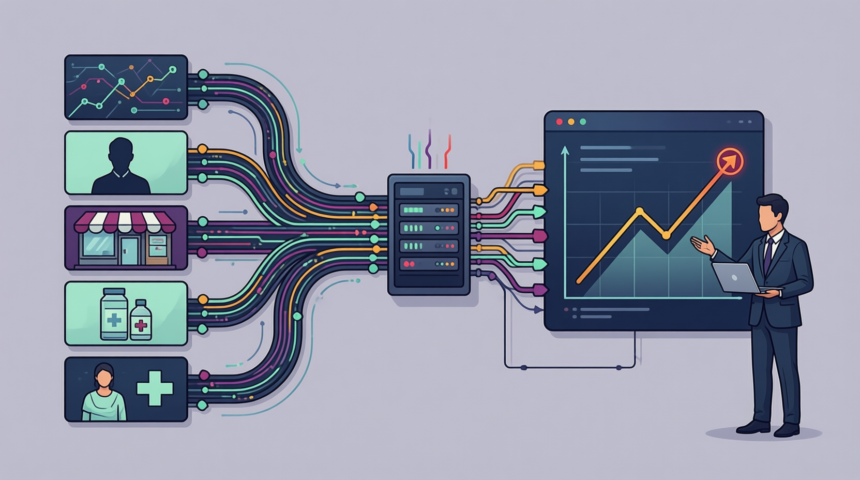
Automation and big data continue to have major impacts within organizations through data automation, pairing automated data collection and processing with big data. How so, you may be wondering. One major application: market intelligence.
- Expand Market Intelligence
- Competitor Research
- Understanding Patients and Customers
- Improves Market Forecasts
- Improved Product Intelligence
- Frequently Asked Questions
- What is the difference between data automation and big data analytics?
- How can a smaller company start using data automation for competitor research without a large budget?
- Conclusion
The term “Market Intelligence,” refers to data collected on the consumer market. This data encapsulates how, why, and when people spend their money.
Naturally, this big data is an invaluable asset to major corporations. Similarly, the harvesting of this data also helps to ensure that consumers are catered to in a way that is most in line with their own habits and wishes.
Today we will be taking a close look at the benefits of data automation for market intelligence in terms of concentrated marketing, market penetration, and strategy. We will also examine how automation and big data continue to improve market intelligence.

The move toward automated data work has stopped being a conversation about what companies might do someday. Workiva’s 2026 Executive Benchmark Survey, which polled 1,497 professionals across finance, accounting, sustainability, internal audit, operations, and legal, found that 79% of business leaders are prioritizing data automation and governance to close data gaps.
“Digital transformation is not just a technology upgrade. It’s a strategic investment in achieving business outcomes like speed to insight, lower operational and compliance risk, and scalable growth. There is a quantifiable cost to the status quo and falling behind competitors.”
Heather Holding, Chief Risk Officer, Best Egg, in Workiva Executive Benchmark Survey, 2026That framing matters because the same data infrastructure that reduces risk on the compliance side is what feeds market intelligence, competitor research, and forecasting on the growth side.
Expand Market Intelligence
Automation is set to simplify and expand the capacity to which market intelligence is harvested. While data collection can require a lot of work when you do it in house, and a lot of money when you do it with the help of a professional, automation programs and sites go a long way towards connecting you quickly and efficiently with important information that you would not have otherwise gotten.
This data can be relatively simple, such as a tracking site like Google Analytics that gives you a quick look at the important components of your web presence. Through this site you can learn what content you put out gets looked at, who is looking at it, and even how much time they spend engaged with it.
This sort of data is invaluable when it comes to learning about the efficiency of your efforts and expanding value. Big data and automation also provides the benefit of delivering real time feedback at a relatively affordable rate.
These automated software programs and websites give companies the opportunity to receive a more expansive look at the Market Intelligence that they are interested in.
A case study published by Northern Light, a market intelligence software vendor, shows what this looks like in practice. A Fortune 500 healthcare enterprise had its market research spread across 35 separate platforms, which led to low employee adoption, overlapping subscription costs, and slow decisions. After the company deployed Northern Light’s SinglePoint platform to bring those sources into a single hub and automate access to them, it reported 2,300 active users, all 35 sources unified in one place, and a 97% automation rate. The company also said 90% of related spending was centralized, research ROI rose 80%, and employee adoption climbed 90%. Since the figures come from the vendor’s own documentation and the client is not named publicly, they should be read as one company’s reported results rather than an industry benchmark.
The broader value of this kind of work is backed by McKinsey research on customer analytics. McKinsey found that intensive users of customer analytics are 23 times more likely to clearly outperform competitors in acquiring new customers, almost 19 times more likely to reach above-average profitability, and nine times more likely to beat competitors on customer loyalty. Those gaps suggest that pulling market intelligence together and putting it to regular use is not a niche improvement for one type of company but a habit that separates strong performers across the board.
For more information on how automation is poised to expand market intelligence, see this guide to conducting competitive research.
Competitor Research
Market intelligence can also help you understand the business structure of your competitors. This can range from anything from information on the effectiveness of their advertising, to their appeal with a variety of different demographics.
No matter how you plan to use competitor research, your efforts in obtaining it are inevitably going to be improved by big data.
Of course, this information must be obtained in a legal manner, but even without shady practices, a lot can be learned about a competitor by studying big data.
In the case of competitor research, you will most likely use the big data primarily to focus on two things:
- The customers of your competitors: Through online research and other methods of data collection, you can find out who (meaning age, gender, economic class etc.) shops with your competitor, and why. You can also find out how they feel about their experiences shopping with your competitor.
- Your competitor’s products: Learning how their products differ from yours is a keen insight on why some people choose to shop elsewhere.
Surveys, social media, and online forums are all great ways of ethically collecting competitor data.
Understanding Patients and Customers
One of the most obvious benefits of market intelligence is that it helps you to understand your patients and customers. This is good from a business standpoint, as it keeps you aware of who you are catering to, but it is also beneficial to the consumer, or, in the case of the healthcare industry, the patient.
In the case of hospitals, big data collection systems such as electronic health records (EHRs) have gone a long way towards ensuring that patients are better taken care of, especially in emergency situations. These records contain information about patient’s health history and have served to reduce the risk of errors in blood transfusions and other standard procedures.
These technologies and practices are currently on the rise and should continue to improve patient care.
Improves Market Forecasts
Big data, particularly the easy collection of big data, also has a big impact on the state of market forecasts. Market forecasts are, of course, a prediction of numbers that are to come.
Since automation and big data supply businesses with more information than ever before, it also helps to ensure that their market forecasts are more accurate.
Improved Product Intelligence
Finally, big data and automation also help to improve product intelligence. It’s a pretty simple equation really: given how quick and comprehensive information is now in the age of automation and big data, companies are now given the opportunity to learn more than ever before about what people do and do not like about their products.
The result is greatly improved product intelligence that should have a significant impact on how companies are able to improve their product marketing and development.
For more information, see this guide to data products.
Frequently Asked Questions
What is the difference between data automation and big data analytics?
Data automation covers the tools and processes that collect, clean, and move data without manual work, such as scheduled pulls from web sources, CRM systems, or sales platforms. Big data analytics is what you do with that data once it is gathered, from spotting demand patterns to segmenting customers. Automation keeps the pipeline full and current, and analytics turns it into decisions. Most organizations need both, since analysis on stale or incomplete data produces stale or incomplete answers.
How can a smaller company start using data automation for competitor research without a large budget?
Start with one narrow question, such as tracking competitor pricing changes or new product launches, rather than trying to monitor everything at once. Set up automated collection from a few public sources like competitor websites, review platforms, and job postings, then route that into a simple dashboard. Review it on a fixed schedule so the data actually informs decisions instead of piling up unread. Expand to new sources only once the first workflow is producing insights the team acts on.
Conclusion
Each of these five uses comes back to the same idea: organizations that collect data automatically and analyze it at scale make decisions on evidence instead of guesswork. Whether the goal is reading a market, watching a competitor, understanding a patient, or refining a product, the underlying capability is the same. The companies that build it now will see more clearly than those that wait.